Dear Greyce,
We have been making progress since I first wrote in (see blog entry Cat Fights in the Family posted 12/30/12). We have been doing a lot of room switching over the last month. Patches and Max have been going to my headquarters (the basement) for an hour or two every day, while I explore the rest of the house. Themselves installed a large crate in the living room which I call 'the apartment'. We all like to nap in it.
On a few occasions when I was in 'the apartment,' Themselves closed its door and then let Max wander around the room. I wasn't too fond of this. I'd hiss when Max got too close or tried to play with my tail.
Last week Themselves reversed the process and closed the door when Max was in 'the apartment'. I went up to the crate and we touched noses. Then I jumped on the loveseat next to the crate and looked out the window. Themselves were so surprised that I took all of this in stride.
To be honest, I have uttered a few hisses when Max suddenly sticks his paw out of 'the apartment' when we are playing with string, but overall things are going well. No fat tails, no big staring eyes. When I'm hunting my new string toy I hardly notice Max until I end up next to 'the apartment' and see him. Then I get a little startled and rush off.
So now I wonder if we are ready for the next step and what that step might be. Should we try putting Patches in the apartment and having me meet her this way? Or should we continue with Max and maybe let us meet without the barrier of the apartment.
What do you advise?
Buddy
Showing posts with label multi-cat household. Show all posts
Showing posts with label multi-cat household. Show all posts
Thursday, July 4, 2013
Sunday, June 16, 2013
Hissy Cat Gets Vet Help: Felice
Dear Greyce,
I just returned home from a visit to my vet and am under the covers in my room. Greyce, the visit was a bit traumatic so I feel the need to hide for awhile. But at the vet office, itself, I behaved most admirably and was admired by all.
The vet was asked if pain could be the cause of my problems. She wiggled all my bits, listened to what Themselves said about the situation, and observed no pain response to anything she did to me. On that basis she concluded that I am healthy but insecure.
I just returned home from a visit to my vet and am under the covers in my room. Greyce, the visit was a bit traumatic so I feel the need to hide for awhile. But at the vet office, itself, I behaved most admirably and was admired by all.
The vet was asked if pain could be the cause of my problems. She wiggled all my bits, listened to what Themselves said about the situation, and observed no pain response to anything she did to me. On that basis she concluded that I am healthy but insecure.


Sunday, June 9, 2013
Hissy Cat Victims Gets Clarification: Felice
Dear Readers: I'm experiencing some format problems so there may be bigger spaces between paragraphs than I'd normally like; and sometimes no breaks at all. My paws have been unable to correct these and Herself - being human - is not capable enough. Please bear with me! G
Dear Greyce,
Dear Greyce,
I've made sure Themselves read your blog entry about me. At least now we are all on the same page, so to meowspeak. The great news is that Himself is now at home, on holiday from college. We have been snuggling a lot!
I may have already mentioned that I do NOT like been shut in a room alone. I detest it and meow loudly to express my dissatisfaction. I always attempt to claw the door open. From time to time, I figure our how to get the door open. I think it is when Himself shuts it but doesn't completely engage the latch.But I must admit that I do quiet down after a while. Raisin also sticks his paw under the door sometimes, when I am in Himself's room; I don't care for that at all.
Of course, what I would really like is to live with Himself and no other cats and have the run of the house.
We go outside together but he keeps a very close eye on me. We sleep together every night he is at home.
He keeps a close eye on me when we walk around the house with my tormentors present, but I was attacked one when his gaze left me. So I am getting more nervous about walking about the house even if my tormentors are elsewhere.
Herself suggested shutting those others in a room while I wander the house. Is this a good idea?
Herself suggested shutting those others in a room while I wander the house. Is this a good idea?
You had asked for more information about the fights and so here goes. As I said, the fights happen at any time and any place. Somehow I always find myself in a corner where I cannot escape. I don't know how this keeps happening.
I think it began - at least with Raisin, when I would hiss and growl when he came into my presence. He would take it as a signal. But now, he goes after me whether or not I make noise. When Raisin is the offender, Herself calls him sharply by name, picks him up and relocates him. She tries to distract him with a toy or some such. She has also used the water squirter and while it works, he soon returns to the matter at hand. If he attacks me, he is put in a closed room for about 10 or 15 minutes.
Rufus usually ignores me when Raisin is bothering me. They seem to take turns. When Rufus viciously attacked me (and also clawed Herself when she intervened), he was put outside.
Soon I will go to the vet and we will discuss medication. I have always been quite temperamental even when I was a kitten - though I can be incredibly affectionate at times. It is like I'm bipolar. I don't want to be on medication but am hoping it will help.
Yours,
Felice
Sunday, May 26, 2013
Hissy Cat Becomes the Victim of Fights in Multi-Cat Household: Felice
Dear Greyce,
 |
| Raisin, Felice and Schatzi: When Times Were Good |
I am a stunning, nine-year-old spayed Sphynx (that's me in the top right corner of the photo) who is terribly insecure and is being picked on by other cats in the household. This can occur at any time of the day or night and in any place in the house! On Herself's bed. In 'my' room (the spare
bedroom). In the kitchen near the food dishes. On the scratching post.
On the stairs. You name it, I'm fair game. Both of the other cats have scratched me and I don't have much protection in the way of fur. Believe me, I don't like them being around me!
A few weeks ago, things escalated. In the middle of the night, Raisin attached me viciously. And now the other cat, Rufus, is back at it, too.
It got so bad that Herself separated me from the rest of the group - and then felt guilty about that. (I also detest not being on the bed with her at night - because the bed is where everyone else congregates. That meant it could be the scene for fights. Or, if I were separated out, she could hear my incessant cat opera at the indignity of it all. Somehow this doesn't seem to mix well with her need for sleep.)
In the interests of keeping me protected I'm living with a neighbour as an only-cat, until a new plan of action can be developed.
So Greyce, why does everyone pick on me so much especially since I don't ever attack them? Do you think I might just be one of those cats who should be an only-cat? What on earth happened?
Saturday, February 2, 2013
Helping Cats to Get Along
Dear Readers,
Sometimes problems come in threes: Three feline families, three cats per family, and none of them happy about it.
There are Raffiki and Black Berry, senior cats with chronic ailments who
feel their home has been invaded by a rambunctious young stray male,
Lucky Little Guy. As far as Lucky is concerned, he'd love to have the
run of the house. And he'd like to pounce on Raffiki. On the other paw,
Raffiki wants to have nothing to do with him. Both senior cats prefurr
to stay locked up away from harm.
There are Tom and Gracie who are having to adapt to the presence of another rambunctious young stray male, Spike. You may remember Tom. He was a stressed out and very ill adult who had great difficulty adapting to his young companion, Gracie, over a year ago and got seriously ill as a result. Thankfully we got him back on track and he and Gracie now live companionably - though he'd prefurr that she not follow him around like a shadow. Meanwhile Spike would like to have the run of the house but neither Gracie nor Tom can cope with that at the moment.
And then there are Patches and Buddy, adult cats quite happily ensconced in their home, only to have it disrupted by the arrival of a rambunctious young male kitten called Max. To make matters worse, Patches went for dental surgery only a few weeks after Max's arrival. When she returned, Buddy did not recognize her! (A common reaction of his, but too much at that moment.) And so his relationship with both his beloved Patches and young Max has been teetering.
These families have a lot in common. They all have purrsons who love them dearly and wish ever so, that everyone would get along. They have visions of a happy cat family filled with pet and purrs. And yet I'm sure if the cats had their way, each of the triad would come to an understanding and the vanquished one would be forced out of the house.
And there's the rub, because they are all indoor cats with no possibility of escape. Besides they all live in winter climates where fending on your own as a stray would be precarious.
What to do?
Almost without exception, cats introduced to other cats too quickly do not get along. We cats know this and we know this well. It's the purrsons in our lives who don't seem to 'get it'. Their idea of a suitable pace is usually far, far faster than some of us can handle.
Even when we give them plenty of evidence that we are not happy, they ignore it - either because they miss the subtle signals by which we usually communicate or because they think we should just work it out amongst ourselves (with no options to leave the house!). So the problem simmers, and simmer and slowly get out of hand.
Usually by the end of the first month, the honeymoon is over. There are fights. Some cats hide. Some start to spray. And others get so stressed they get sick. Even the thickest purrson will understand that there are problems when the yowling starts, the fur flies, and there are trips to the vet to deal with puncture wounds.
They say things to each other such as,
"Why is this happening?" they wonder. "We love them dearly. They have everything they need. Why can't they just get along?"
or
" Does this mean that (insert whatever name you wish) has to be re-homed? I can't stand the thought of him/her leaving!"
or
"I must be a bad cat purrson."
Have no fear, fellow felines. Your purrsons are not bad, though they may feel guilty or angry or just confused. They are ignorant in the true sense of the word, meaning that while their intentions are good, they just don't know any better. And that is where I come it, because I can provide you with information to share with them, to try to get them on board.
General Principles for Solving this Problem
Regular readers of my blog will note that my advice on this matter tends to go along the following lines:
1. An explanation of the importance we place on our territory.
2. Education about the ways in which we communicate.
3. Anxiety: How it works with us and what to do about it.
4. How to step back and start over.
So let me take each of these and expand.
1. An explanation of the importance we place on our territory.
Educate your purrsons about territory and its importance to us. Take it from me; most of them haven't a clue about why we get anxious when it is disrupted.
Here are the key points to emphasize:
We are territorial animals. In the wild, unless we live in a feral colony (with abundant shelter, food and water), we will tend to be solitary. We establish individual (though overlapping) territories sufficient to support ourselves and only ourselves. Our territories can be huge or small (depending upon our purrsonality, sexual status and the availability of key resources). We patrol our territorial several times a day to ensure that it is secure.
Our territory is so important that we may go without food or sex or proper sleep if it is under threat; it is our MOST important asset. A change of food source, litterbox location or water bowl sends off an alarm. Change could mean a change from abundance to scarcity! And this is especially so, if a new cat enters the territory and attempts to settle in.
Okay, I can hear your purrsons now. "But we introduced Fluffy, a new baby kitten, and everything went so well."
Well that depends. The biggest chance of a quicker-paced introduction involves a very young kitten (because we adults are pre-disposed to be more accepting of them) and a household where the rest of us tend to be friendly to our species and laid-back. Then the process of getting to know one another will be relatively quick. But that doesn't happen that often.
Usually our first thought upon the entry of such an invader if of THREAT! Our next, to get rid of the invader or, if we feel very vulnerable, to hide. This is the context within which introductions to new cats in the family have to take place.
Just because we behave so like our wild ancestors, some purrsons think we should get over it. But as you know, they are territorial beings too. Just last week, Herself got her knickers in a twist because someone else took 'her' parking space in front of our home; and we don't even have a car! And lots of people who attend meetings return to the same spot after taking a group break; wow, do they get bent out of shape if someone else is sitting in 'their' seat. And let's not get started about how distressed some get if something they value (like a picture or even a mixing bowl) gets moved from its regular place by someone else.
Solving the Problems with Territoriality
There are several ways to deal with territorial issues.
- Put the newcomer in a safe and secure space, to start getting used to the new home. It takes a lot for a newcomer to get used to the location of everything, to incorporate household smells into his or her smell profile of friendly things, and generally to get the lay of the land. That is why I recommend starting in a safe and secure space and only when adjusted to it, to start to explore the rest of the place - beginning with small amounts of time and small amounts of space.
- We all feel better if resources are abundant. And so with the arrival of feline number three should also come the arrival of an extra litter box or two - distributed throughout our territory rather than put along with what we already have. Ditto, an extra water bowl or two and an extra feeding area and things to scratch. A few more toys are not out of order.
And most importantly, give some consideration to important aspects of feline interior design - sufficient viewing perches, sleeping areas and monitoring sites. Many households (in spite of my harping) still have far few levels on which we cats can arrange ourselves. For many of us, being off the ground is a way to reduce the stress of feeling crowded by an additional cat. And if there are more than two of us, we do better if those off-the-ground sites are staggered at different levels. That way, either the most confident or the most frightened of us can go to the top level (scared cats tend to like either very high places or places on the ground behind things) and the rest of us can arrange ourselves accordingly.
Unless we are very, very good friends, we prefurr staggered levels in the cat class system. That way we each have our place in relation to everyone else. And that is why I'm in favour of cat trees, cat shelving systems and more than one of each in every home. They don't have to be fancy or expensive. They just have to do their job.
Resources
Behaviourist Jackson Galaxy refurrs to feline interior design as Catification and there are lots of ideas on his site. Also check out Hauspanther by clicking on "Design Finds" for inspiration. And there is my entry, A Cat Tree for Every Cat (2/7/10).
2. Education about the ways in which we communicate.
Your purrsons need to know about cat signalling systems so they can tell when we are are about to become angry, or frightened, or anxious. Distraction (through the use of a "no" or a hand clap or a wand toy, etc.) is such a wonderful way of breaking off the potential for aggression. But it will only work if they catch the subtle signs before things start to blossom and get our of hand. And knowing when one of us is just starting to get uncomfortable is an excellent way of telling when an introduction session should come to an end. In other words, if they do not know how we communicate with each other, they cannot intervene appropriately and we are left to fend for ourselves.
Purrsons think they largely communicate by speaking - except for the younger generation that thinks that texting takes its place. Both are wrong.
Over 90% of human communication is non-verbal (which is why e-mails, texting and Facebook entries can so easily be misunderstood). Humans rely on physical distance, pupil size, facial expression, head tilt, eye contact, posture and a host of other cues - only they are not that conscious of doing so. When speech and body cues do not match, the purrson gets an uneasy feeling but cannot quite say why.
So let's face it, fellow felines. We are dealing with people who use sophisticated systems themselves but haven't got a conscious clue about them. Don't forget, these are the same people who visit France and get upset when the French don't speak English! If you live with these kinds of purrsons, you will have your work cut out for you.
We cats have a sophisticated communications system which seldom requires vocalizing (unless humans are involved). Ear position, whisker position, pupil size, tail manner, staring, posture and proximity to another feline are solid cues about what we are thinking; not to mention purrs, meows, and yowls. But for many purrsons, we have to get to the yowling stage before they notice something is wrong. So do yourselves a favour and swat them silly until they read and understand some key resources:
Resources
As many of you know, I am a great fan of photo books that capture cat communication. Check out relevant cat books by Roger Tabor and by Bruce Fogel (which you can order or likely get from your library). Tabor
is famous for his careful studies of the feline world. Fogel is a well-respected veterinarian.
I like Tabor's Understanding Cat Behavior and his 100 Ways to Better Understand Your Cat. And I enjoy the photos in Fogel's Know Your Cat. Both authors are prolific writers and have many other relevant books from which to choose.
Also Raffiki strongly recommends Tabor's video, Understanding Cats (dvd) because it so clearly shows what feline aggression looks like and how we hunt (to give our purrsons better ideas on how to play with us).
Amy Shojai has at least three entries (likely more) of interest on this topic:
http://cats.about.com/od/
http://cats.about.com/od/
http://cats.about.com/od/
3. Anxiety: How it works with us and what to do about it.
Every day our anxiety levels go up and down because we are wired to be predators. Increased arousal (anxiety) gets us off our butts and out to hunt. And even though our food comes from a can or a bag, we still think as hunters. And once we have hunted, we eat and then relax because our arousal level lowers.
If we don't get the chance to reduce our arousal level, it stays up. After a while (days or weeks) we can be so fired up that even something relatively small can set us off. We become reactive, meaning that we over-react to whatever comes our way. And then problems start.
Solving the Problem of Anxiety
If we don't get hunting opportunities, then we need to simulate them through predatory play. Such play involves another party. If we are matched in purrsonality and energy level, then we can take turns being victim and victor with a feline companion - often several times in a play session. If not, then we need help.
Not the so-called well-meaning help of solitary play toys; in the absence of live prey we need things that move and behave like prey. That is why I've taken such pains to describe appropriate kinds of toys and most importantly how you need to train your purrson to play with you.
Because most people get their ideas of appropriate play from commercials that are designed to show off the toy rather than demonstrate a proper play session, they think that just waving the toy in front of you (which usually triggers our defensive reactions) is all there is to it. They need to learn that this is not enough before we give up on them.
Daily interactive play sessions are one of the best and least expensive ways to reduce anxiety. But there are others.
Alter the design of your home to increase abundance, offer staggered levels in three-dimensions thorough cat trees and shelving, or closeoff areas so time-sharing can occur between cats that are still getting to know one another. I've already outlined this in discussing territory.
Many purrsons prefurr to sit on the sofa and have you sit on or beside them. Nice for them. Not great for you when you are uptight. At the very least, get them versed in some form of touch therapy (meditative stroking, Reiki, Therapeutic Touch or massage).
And if you need extra help, there are anti-anxiety medications (and non-pharmaceutical calmatives) and Feliway.
Speaking of anxiety, one of the contributing factors is your purrsons' anxiety levels. Tell them to chill. They need to know that we are excellent readers of their moods. Faster heart and respiration rates, changing body odours, postures, and changes in voice pitch and speed can all tell us that they are uptight. If they are going to work with us, they need to relax. Have them take some deep, regular breaths to cause their bodies to relax, and make sure they read the resource materials to get their confidence up.
Resources
On interactive play, consult my entry, Three Black Cats Who Don't Get Along (8/14/12) or
Cat Stalks Human: Tux's Trials (December 11, 2011). Both contain detailed descriptions of the rationale behind and method of implementing the necessary play sessions.
The Feliway entry is What Good Is Feliway? (4/30/10)
On touch, go to my entry, Lifting the Sadness - The Healing Power of Touch (1/28/10) or Meditative Stroking - Touch That Can Heal (1/20/10).
4. How to step back and start over.
Since you are in a confined system, that is, one in which you are not free to leave if and when you choose, you must go back to square one in your introduction process - with the newcomer sequestered in a safe and separate area, and start over, s-l-o-w-l-y.
I've outlined a typical series of steps in my entry May I Present? Another Cat! (1/14/10)
When more than two cats are involved (like one newcomer and two residents) then the steps need to be modified, depending on the ages and purrsonalities of those involved. And each family has its idiosyncracies and special needs.
For example, Max, Patches and Buddy live with two purrsons but one is out of town for long stretches. This means that Herself must manage on her own, so advice involving two purrsons will be more difficult for her to implement. We have to get more creative and offer one-purrson solutions here.
In Tom, Grace and Spike's home, Tom has greater-than-usual difficulty accepting new things and is easily stressed. So it is very important that things proceed at an even slower pace in order for him to feel comfortable. In his case, letting him be and working on getting Gracie and Spike acquainted takes priority.
In Raffiki, Black Berry and Lucky Little Guy's household, the cats get along better outside (where Lucky has an enclosure); but the Canadian climate means this is not an option for almost six months of the year. Inside the house, Raffiki and Black Berry refuse to come out of the bedroom when Lucky is upstairs, even if Lucky is in his very luxurious cat apartment in the living room.
Forcing them to come out is far from easy, because the senior cats have illnesses that can be made worse by stress and because the open plan of their home makes it easy for them to hide elsewhere. Besides, their purrsons are reluctant to force anything, having has to intervene in too many cat fights.
In this situation, one of the best things they can do is to pool their catnip allowances to hire someone to cut an opening in the bottom third of the bedroom door and securely line it with hardware cloth - so they can start establishing visual access with Lucky, without having to have physical contact with him. It would start with the opening being fully covered over (with, say, cardboard) and then, as all cats get used to it, raising it an 2.5 cm (1 American inch) at a time; letting everyone get used to that before moving it up yet another inch - until all is fully revealed. This gives everyone a chance to adapt to full visual access and yet no one can harm the other because their paws won't fit through this extra-thick screening.
You can gather than theirs will be a slow process. But moving slowly in the right direction is much better than not at all.
So as you can see, while each family is asked to follow the same set of guidelines, the way in which they are implemented varies with the household. Besides purrsons often lack the confidence (or know-how) to understand when we are truly ready for the next step in the introduction process, and so they like to e-mail me just to be sure. And sometimes there are setbacks and everyone needs re-assurance of how to get the situation under control.
So while you are reading the blog entries, know that many times they are the result of more frequent e-mails back-and-forth to settle the details with the respective households.
And if you are interested in following the adventures of the three cat families in this entry, here are the blog entries about them to date:
Raffiki, Black Berry and Lucky Little Guy
Three Black Cats Who Don't Get Along (8/14/12)
Three Black Cats Who Don't Get Along: Progress Report (9/18/12)
Tom, Gracie and Spike
Newcomer Hampers Sick Cat's Recovery (4/4/11)
Re-integration After Disaster: Old and Young Cats (5/4/11)
And Now We Are 3: Getting Used to Another Cat (12//3112)
Getting Used to a Third Cat: Tommy, Gracie and Spike (1/14/13)
Buddy, Patches and Max
Cat Fights in the Family: For Buddy the Pressure is TOO Much (12/30/12)
Keep your paws crossed that there are happy endings for each of these families. With knowledge, patience, and consistency, such integration usually works.
Purrs and whisker kisses,
Greyce
Sometimes problems come in threes: Three feline families, three cats per family, and none of them happy about it.
 |
| Lucky Little Guy |
 |
| Gracie and Tom |
 |
| Patches and Buddy |
These families have a lot in common. They all have purrsons who love them dearly and wish ever so, that everyone would get along. They have visions of a happy cat family filled with pet and purrs. And yet I'm sure if the cats had their way, each of the triad would come to an understanding and the vanquished one would be forced out of the house.
And there's the rub, because they are all indoor cats with no possibility of escape. Besides they all live in winter climates where fending on your own as a stray would be precarious.
What to do?
Almost without exception, cats introduced to other cats too quickly do not get along. We cats know this and we know this well. It's the purrsons in our lives who don't seem to 'get it'. Their idea of a suitable pace is usually far, far faster than some of us can handle.
Even when we give them plenty of evidence that we are not happy, they ignore it - either because they miss the subtle signals by which we usually communicate or because they think we should just work it out amongst ourselves (with no options to leave the house!). So the problem simmers, and simmer and slowly get out of hand.
Usually by the end of the first month, the honeymoon is over. There are fights. Some cats hide. Some start to spray. And others get so stressed they get sick. Even the thickest purrson will understand that there are problems when the yowling starts, the fur flies, and there are trips to the vet to deal with puncture wounds.
They say things to each other such as,
"Why is this happening?" they wonder. "We love them dearly. They have everything they need. Why can't they just get along?"
or
" Does this mean that (insert whatever name you wish) has to be re-homed? I can't stand the thought of him/her leaving!"
or
"I must be a bad cat purrson."
Have no fear, fellow felines. Your purrsons are not bad, though they may feel guilty or angry or just confused. They are ignorant in the true sense of the word, meaning that while their intentions are good, they just don't know any better. And that is where I come it, because I can provide you with information to share with them, to try to get them on board.
General Principles for Solving this Problem
Regular readers of my blog will note that my advice on this matter tends to go along the following lines:
1. An explanation of the importance we place on our territory.
2. Education about the ways in which we communicate.
3. Anxiety: How it works with us and what to do about it.
4. How to step back and start over.
So let me take each of these and expand.
1. An explanation of the importance we place on our territory.
Educate your purrsons about territory and its importance to us. Take it from me; most of them haven't a clue about why we get anxious when it is disrupted.
Here are the key points to emphasize:
We are territorial animals. In the wild, unless we live in a feral colony (with abundant shelter, food and water), we will tend to be solitary. We establish individual (though overlapping) territories sufficient to support ourselves and only ourselves. Our territories can be huge or small (depending upon our purrsonality, sexual status and the availability of key resources). We patrol our territorial several times a day to ensure that it is secure.
Our territory is so important that we may go without food or sex or proper sleep if it is under threat; it is our MOST important asset. A change of food source, litterbox location or water bowl sends off an alarm. Change could mean a change from abundance to scarcity! And this is especially so, if a new cat enters the territory and attempts to settle in.
Okay, I can hear your purrsons now. "But we introduced Fluffy, a new baby kitten, and everything went so well."
Well that depends. The biggest chance of a quicker-paced introduction involves a very young kitten (because we adults are pre-disposed to be more accepting of them) and a household where the rest of us tend to be friendly to our species and laid-back. Then the process of getting to know one another will be relatively quick. But that doesn't happen that often.
Usually our first thought upon the entry of such an invader if of THREAT! Our next, to get rid of the invader or, if we feel very vulnerable, to hide. This is the context within which introductions to new cats in the family have to take place.
Just because we behave so like our wild ancestors, some purrsons think we should get over it. But as you know, they are territorial beings too. Just last week, Herself got her knickers in a twist because someone else took 'her' parking space in front of our home; and we don't even have a car! And lots of people who attend meetings return to the same spot after taking a group break; wow, do they get bent out of shape if someone else is sitting in 'their' seat. And let's not get started about how distressed some get if something they value (like a picture or even a mixing bowl) gets moved from its regular place by someone else.
Solving the Problems with Territoriality
There are several ways to deal with territorial issues.
- Put the newcomer in a safe and secure space, to start getting used to the new home. It takes a lot for a newcomer to get used to the location of everything, to incorporate household smells into his or her smell profile of friendly things, and generally to get the lay of the land. That is why I recommend starting in a safe and secure space and only when adjusted to it, to start to explore the rest of the place - beginning with small amounts of time and small amounts of space.
- We all feel better if resources are abundant. And so with the arrival of feline number three should also come the arrival of an extra litter box or two - distributed throughout our territory rather than put along with what we already have. Ditto, an extra water bowl or two and an extra feeding area and things to scratch. A few more toys are not out of order.
And most importantly, give some consideration to important aspects of feline interior design - sufficient viewing perches, sleeping areas and monitoring sites. Many households (in spite of my harping) still have far few levels on which we cats can arrange ourselves. For many of us, being off the ground is a way to reduce the stress of feeling crowded by an additional cat. And if there are more than two of us, we do better if those off-the-ground sites are staggered at different levels. That way, either the most confident or the most frightened of us can go to the top level (scared cats tend to like either very high places or places on the ground behind things) and the rest of us can arrange ourselves accordingly.
Unless we are very, very good friends, we prefurr staggered levels in the cat class system. That way we each have our place in relation to everyone else. And that is why I'm in favour of cat trees, cat shelving systems and more than one of each in every home. They don't have to be fancy or expensive. They just have to do their job.
Resources
Behaviourist Jackson Galaxy refurrs to feline interior design as Catification and there are lots of ideas on his site. Also check out Hauspanther by clicking on "Design Finds" for inspiration. And there is my entry, A Cat Tree for Every Cat (2/7/10).
2. Education about the ways in which we communicate.
Your purrsons need to know about cat signalling systems so they can tell when we are are about to become angry, or frightened, or anxious. Distraction (through the use of a "no" or a hand clap or a wand toy, etc.) is such a wonderful way of breaking off the potential for aggression. But it will only work if they catch the subtle signs before things start to blossom and get our of hand. And knowing when one of us is just starting to get uncomfortable is an excellent way of telling when an introduction session should come to an end. In other words, if they do not know how we communicate with each other, they cannot intervene appropriately and we are left to fend for ourselves.
Purrsons think they largely communicate by speaking - except for the younger generation that thinks that texting takes its place. Both are wrong.
Over 90% of human communication is non-verbal (which is why e-mails, texting and Facebook entries can so easily be misunderstood). Humans rely on physical distance, pupil size, facial expression, head tilt, eye contact, posture and a host of other cues - only they are not that conscious of doing so. When speech and body cues do not match, the purrson gets an uneasy feeling but cannot quite say why.
So let's face it, fellow felines. We are dealing with people who use sophisticated systems themselves but haven't got a conscious clue about them. Don't forget, these are the same people who visit France and get upset when the French don't speak English! If you live with these kinds of purrsons, you will have your work cut out for you.
We cats have a sophisticated communications system which seldom requires vocalizing (unless humans are involved). Ear position, whisker position, pupil size, tail manner, staring, posture and proximity to another feline are solid cues about what we are thinking; not to mention purrs, meows, and yowls. But for many purrsons, we have to get to the yowling stage before they notice something is wrong. So do yourselves a favour and swat them silly until they read and understand some key resources:
Resources
As many of you know, I am a great fan of photo books that capture cat communication. Check out relevant cat books by Roger Tabor and by Bruce Fogel (which you can order or likely get from your library). Tabor
is famous for his careful studies of the feline world. Fogel is a well-respected veterinarian.
I like Tabor's Understanding Cat Behavior and his 100 Ways to Better Understand Your Cat. And I enjoy the photos in Fogel's Know Your Cat. Both authors are prolific writers and have many other relevant books from which to choose.
 |
| Raffiki Recommends the DVD |
Amy Shojai has at least three entries (likely more) of interest on this topic:
http://cats.about.com/od/
http://cats.about.com/od/
http://cats.about.com/od/
3. Anxiety: How it works with us and what to do about it.
Every day our anxiety levels go up and down because we are wired to be predators. Increased arousal (anxiety) gets us off our butts and out to hunt. And even though our food comes from a can or a bag, we still think as hunters. And once we have hunted, we eat and then relax because our arousal level lowers.
If we don't get the chance to reduce our arousal level, it stays up. After a while (days or weeks) we can be so fired up that even something relatively small can set us off. We become reactive, meaning that we over-react to whatever comes our way. And then problems start.
Solving the Problem of Anxiety
If we don't get hunting opportunities, then we need to simulate them through predatory play. Such play involves another party. If we are matched in purrsonality and energy level, then we can take turns being victim and victor with a feline companion - often several times in a play session. If not, then we need help.
Not the so-called well-meaning help of solitary play toys; in the absence of live prey we need things that move and behave like prey. That is why I've taken such pains to describe appropriate kinds of toys and most importantly how you need to train your purrson to play with you.
Because most people get their ideas of appropriate play from commercials that are designed to show off the toy rather than demonstrate a proper play session, they think that just waving the toy in front of you (which usually triggers our defensive reactions) is all there is to it. They need to learn that this is not enough before we give up on them.
Daily interactive play sessions are one of the best and least expensive ways to reduce anxiety. But there are others.
Alter the design of your home to increase abundance, offer staggered levels in three-dimensions thorough cat trees and shelving, or closeoff areas so time-sharing can occur between cats that are still getting to know one another. I've already outlined this in discussing territory.
Many purrsons prefurr to sit on the sofa and have you sit on or beside them. Nice for them. Not great for you when you are uptight. At the very least, get them versed in some form of touch therapy (meditative stroking, Reiki, Therapeutic Touch or massage).
And if you need extra help, there are anti-anxiety medications (and non-pharmaceutical calmatives) and Feliway.
Speaking of anxiety, one of the contributing factors is your purrsons' anxiety levels. Tell them to chill. They need to know that we are excellent readers of their moods. Faster heart and respiration rates, changing body odours, postures, and changes in voice pitch and speed can all tell us that they are uptight. If they are going to work with us, they need to relax. Have them take some deep, regular breaths to cause their bodies to relax, and make sure they read the resource materials to get their confidence up.
Resources
On interactive play, consult my entry, Three Black Cats Who Don't Get Along (8/14/12) or
Cat Stalks Human: Tux's Trials (December 11, 2011). Both contain detailed descriptions of the rationale behind and method of implementing the necessary play sessions.
The Feliway entry is What Good Is Feliway? (4/30/10)
On touch, go to my entry, Lifting the Sadness - The Healing Power of Touch (1/28/10) or Meditative Stroking - Touch That Can Heal (1/20/10).
4. How to step back and start over.
Since you are in a confined system, that is, one in which you are not free to leave if and when you choose, you must go back to square one in your introduction process - with the newcomer sequestered in a safe and separate area, and start over, s-l-o-w-l-y.
I've outlined a typical series of steps in my entry May I Present? Another Cat! (1/14/10)
When more than two cats are involved (like one newcomer and two residents) then the steps need to be modified, depending on the ages and purrsonalities of those involved. And each family has its idiosyncracies and special needs.
For example, Max, Patches and Buddy live with two purrsons but one is out of town for long stretches. This means that Herself must manage on her own, so advice involving two purrsons will be more difficult for her to implement. We have to get more creative and offer one-purrson solutions here.
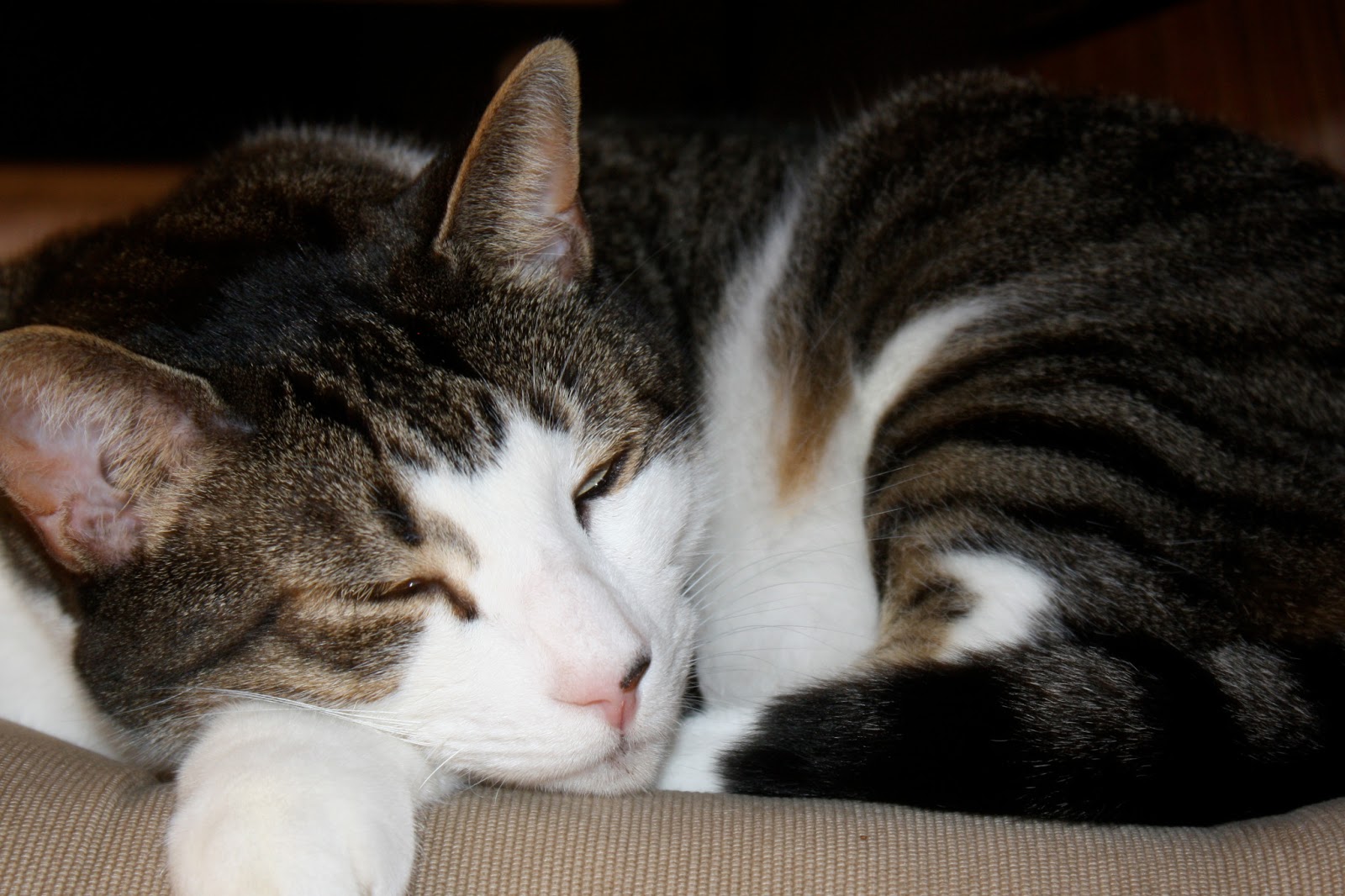 |
| Tom wants to be alone |
In Raffiki, Black Berry and Lucky Little Guy's household, the cats get along better outside (where Lucky has an enclosure); but the Canadian climate means this is not an option for almost six months of the year. Inside the house, Raffiki and Black Berry refuse to come out of the bedroom when Lucky is upstairs, even if Lucky is in his very luxurious cat apartment in the living room.
Forcing them to come out is far from easy, because the senior cats have illnesses that can be made worse by stress and because the open plan of their home makes it easy for them to hide elsewhere. Besides, their purrsons are reluctant to force anything, having has to intervene in too many cat fights.
In this situation, one of the best things they can do is to pool their catnip allowances to hire someone to cut an opening in the bottom third of the bedroom door and securely line it with hardware cloth - so they can start establishing visual access with Lucky, without having to have physical contact with him. It would start with the opening being fully covered over (with, say, cardboard) and then, as all cats get used to it, raising it an 2.5 cm (1 American inch) at a time; letting everyone get used to that before moving it up yet another inch - until all is fully revealed. This gives everyone a chance to adapt to full visual access and yet no one can harm the other because their paws won't fit through this extra-thick screening.
You can gather than theirs will be a slow process. But moving slowly in the right direction is much better than not at all.
So as you can see, while each family is asked to follow the same set of guidelines, the way in which they are implemented varies with the household. Besides purrsons often lack the confidence (or know-how) to understand when we are truly ready for the next step in the introduction process, and so they like to e-mail me just to be sure. And sometimes there are setbacks and everyone needs re-assurance of how to get the situation under control.
So while you are reading the blog entries, know that many times they are the result of more frequent e-mails back-and-forth to settle the details with the respective households.
And if you are interested in following the adventures of the three cat families in this entry, here are the blog entries about them to date:
Raffiki, Black Berry and Lucky Little Guy
Three Black Cats Who Don't Get Along (8/14/12)
Three Black Cats Who Don't Get Along: Progress Report (9/18/12)
Tom, Gracie and Spike
Newcomer Hampers Sick Cat's Recovery (4/4/11)
Re-integration After Disaster: Old and Young Cats (5/4/11)
And Now We Are 3: Getting Used to Another Cat (12//3112)
Getting Used to a Third Cat: Tommy, Gracie and Spike (1/14/13)
Buddy, Patches and Max
Cat Fights in the Family: For Buddy the Pressure is TOO Much (12/30/12)
Keep your paws crossed that there are happy endings for each of these families. With knowledge, patience, and consistency, such integration usually works.
Purrs and whisker kisses,
Greyce
Tuesday, September 18, 2012
Three Black Cats Who Don't Get Along: Progress Report
Dear Greyce,
 Things have improved since we last contacted you.
Lucky Little Guy's outdoor kennel has been moved closer to where the rest of us hang out in the backyard. And Themselves think this is a great idea. We have all been out in the yard quite a bit.
Lucky and I have been having a lot of outdoor conversations. I mutter, moan and then charge his kennel. He stops about 2 feet away, turns his back and walks away; then he watches me.
However I've now been mounting Black Berry - often in front of Lucky. What's with that?
Back to my relationship with Lucky, we have had some under-the-door paw play when we are indoors. Unfortunately a loud noise scared us both and so we stopped.
Lucky has been putting on weight. Will vigourous workouts help trim his size? Using a food ball has helped, somewhat. I think he really misses running free and climbing trees. Herself did take him out and play chase - which he loved. Does he need more of that?
So Greyce, when do we take the next step in re-integration?
That's all for now,
Raffiki

Lucky Little Guy's outdoor kennel has been moved closer to where the rest of us hang out in the backyard. And Themselves think this is a great idea. We have all been out in the yard quite a bit.
Lucky and I have been having a lot of outdoor conversations. I mutter, moan and then charge his kennel. He stops about 2 feet away, turns his back and walks away; then he watches me.
However I've now been mounting Black Berry - often in front of Lucky. What's with that?
Back to my relationship with Lucky, we have had some under-the-door paw play when we are indoors. Unfortunately a loud noise scared us both and so we stopped.
Lucky has been putting on weight. Will vigourous workouts help trim his size? Using a food ball has helped, somewhat. I think he really misses running free and climbing trees. Herself did take him out and play chase - which he loved. Does he need more of that?
So Greyce, when do we take the next step in re-integration?
That's all for now,
Raffiki
Monday, August 20, 2012
Molly Cat Pulls Out Her Fur
Dear Greyce,
I am a 13-year-old spayed female with a long but thin grey and white fur coat. I have been a fur-puller - hind quarters are my specialty - for several years. I pull and eat my fur and then vomit up hairballs. And it is getting worse.
I am a 13-year-old spayed female with a long but thin grey and white fur coat. I have been a fur-puller - hind quarters are my specialty - for several years. I pull and eat my fur and then vomit up hairballs. And it is getting worse.
Saturday, August 18, 2012
The Cat Who Eats Too Much: Kitty's Story
Dear Greyce,
I'm an 11-year old, long-haired beauty with a problem: I want to eat all the time and it is getting me into a lot of trouble.
Tuesday, August 14, 2012
Three Black Cats Who Don't Get Along
Dear Greyce,
We are three black cats who don't get along. It's complicated: You see, some of us do and some of us don't - some of the time. So let's begin at the beginning.
We are three black cats who don't get along. It's complicated: You see, some of us do and some of us don't - some of the time. So let's begin at the beginning.
Sunday, August 5, 2012
Victory over Cat Urine and Intercat Aggression: Minou's Marvellous Makeover
Dear Greyce,
It has been a few months since we got your advice. (See entry The Urine Marking and Cat Fighting Combo of April 5, 2012). As you will recall, I as peeing a lot, fighting with Cassie, my feline companion, and Themselves were about to deal with a kitchen renovation and add to another potential tail-grabber to the family. It's been a busy time.
Despite your advice to board us during the kitchen renovation, Himself was adamant that we stay in the basement by day and be given free reign by night to check out the day's progress. We made it through three weeks of demolition and reconstruction with only one (yes, just one!) peeing incident in the basement and one peeing incident in the kitchen when the contractor left one of his drop cloths on the floor. He said this has happened before, so no doubt we smelled the other animals and felt the need to mark our territory. And that is why I don't think that particular incident should even count.
Herself ordered the Anti -Icky-Poo and the pre-treatment on-line to remove the residue of any previous cleaners used and well as residual urine. She cleaned every spot we have ever peed on and it seems to have worked as we have not peed in any of these places since! Well worth the $60 they paid, especially compared to the hundreds they previously spent on cleaners.
Himself also removed some of the trim and baseboards I had peed on, cleaned and sprayed underneath them, then replaced them with new pieces.
At the front entrance where we always peed repeatedly he did the same. And for good measure they placed a SSSCAT sprayer that has a motion sensor and scares me away with a spray of air if I get too close.
Himself has been keeping on top of our litter box cleanliness and Herself now consistently buys the litter which has worked well for us and minimized odours (Catit Multi-Cat Litter).
There are fewer places for me to corner Cassie and fight because of the new kitchen layout, as well as Themselves giving us each our own eating spot. And they separated our water on its own, away from our food.
They are still using Feliway on each of the two floors we are allowed on and this seems to help. We are still barred from the bedrooms.
Overall things are pretty good. Even new Baby Himself hasn't caused us any noteworthy stress. And all of the visitors who come to adore him give us lots of extra love. It is nice having Herself home everyday, too.
So thanks again for the great advice.You seriously saved me!
With gratitude,
Minou
_____________________
Dear Minou,
I am purring with delight at the thought of a much happier household for all of you and most particularly for Cassie and yourself. Keep up the good work!
And readers, please note that I added links to the products Minou mentioned because inquiring cats will want to know.
Whisker kisses,
Greyce
It has been a few months since we got your advice. (See entry The Urine Marking and Cat Fighting Combo of April 5, 2012). As you will recall, I as peeing a lot, fighting with Cassie, my feline companion, and Themselves were about to deal with a kitchen renovation and add to another potential tail-grabber to the family. It's been a busy time.
Despite your advice to board us during the kitchen renovation, Himself was adamant that we stay in the basement by day and be given free reign by night to check out the day's progress. We made it through three weeks of demolition and reconstruction with only one (yes, just one!) peeing incident in the basement and one peeing incident in the kitchen when the contractor left one of his drop cloths on the floor. He said this has happened before, so no doubt we smelled the other animals and felt the need to mark our territory. And that is why I don't think that particular incident should even count.
Herself ordered the Anti -Icky-Poo and the pre-treatment on-line to remove the residue of any previous cleaners used and well as residual urine. She cleaned every spot we have ever peed on and it seems to have worked as we have not peed in any of these places since! Well worth the $60 they paid, especially compared to the hundreds they previously spent on cleaners.
Himself also removed some of the trim and baseboards I had peed on, cleaned and sprayed underneath them, then replaced them with new pieces.
At the front entrance where we always peed repeatedly he did the same. And for good measure they placed a SSSCAT sprayer that has a motion sensor and scares me away with a spray of air if I get too close.
Himself has been keeping on top of our litter box cleanliness and Herself now consistently buys the litter which has worked well for us and minimized odours (Catit Multi-Cat Litter).
There are fewer places for me to corner Cassie and fight because of the new kitchen layout, as well as Themselves giving us each our own eating spot. And they separated our water on its own, away from our food.
They are still using Feliway on each of the two floors we are allowed on and this seems to help. We are still barred from the bedrooms.
Overall things are pretty good. Even new Baby Himself hasn't caused us any noteworthy stress. And all of the visitors who come to adore him give us lots of extra love. It is nice having Herself home everyday, too.
So thanks again for the great advice.You seriously saved me!
With gratitude,
Minou
_____________________
Dear Minou,
I am purring with delight at the thought of a much happier household for all of you and most particularly for Cassie and yourself. Keep up the good work!
And readers, please note that I added links to the products Minou mentioned because inquiring cats will want to know.
Whisker kisses,
Greyce
Monday, July 30, 2012
Update on Nina and Asjas: Kitten to Cat Introduction Process
Dearest Precious Greyce,
You will recall that I summoned your assistance to deal with the relationship between my companion, Asjas, and myself, went from bad to worse. (See Introducing Kitten to Scared Cat: Nina & Asjas - June 17, 2012)
Things are improving between Asjas and myself. We have reached a point where one of us is able to explore the rest of the house while the other is kept busy in another room behind a closed door.
You will recall that I summoned your assistance to deal with the relationship between my companion, Asjas, and myself, went from bad to worse. (See Introducing Kitten to Scared Cat: Nina & Asjas - June 17, 2012)
Things are improving between Asjas and myself. We have reached a point where one of us is able to explore the rest of the house while the other is kept busy in another room behind a closed door.
Friday, June 29, 2012
Re-integrating Cat Friends at War: Lily and Misha
Dear Greyce,
We are lovely young cats, ages 1 and 2, who have been close friends since the younger (Misha) arrived at age 2 months. For the past few months our relationship has faltered badly.
It all began when Misha spent 2 days at the vet's being spayed. When she returned, I didn't recognize her; she smelled funny and wore a stocking (to prevent her from picking out her stitches). I was scared of her and became aggressive. She was scared by my behaviour. I'll spare you the details, Greyce, but it was awful.
Thursday, April 5, 2012
The Urine Marking & Cat Fighting Combo
Dear Greyce,
 I am a beautiful, 9-year-old, spayed female with a complicated problem: I pee all over the house and I fight with my feline sister, Cassie. And this has been going on for a long time.

Thursday, October 13, 2011
Aggression Between Cats: Update on Ziggy & Pearl
Dear Greyce,
We have tried two of your suggestions already.
First, Herself now intervenes within the first 30 seconds of my staring and Pearl and hey . . . I think I'm getting it now. I understand that she is NOT pleased when I do that. I really want to keep doing it, but I'm trying to behave. So I only stared at Pearl twice last night which is a record. Because in the last couple of months I average five or more times a night.
Second, Herself is spending longer periods of individual time with Pearl, as you also suggested. I'm not happy about that, but Pearl certainly is. And she seems a little less stressed.
So it seems like we've started the road back to a more peaceable kingdom - like we used to have.
Now I have a question for you. You suggested a cat apartment (wire dog crate) for Pearl. How about me?
Themselves were wondering if we could have one each. That way, we could be in the same general vicinity at times, without Pearl stressing out. It would also make it easier to switch us between the bedroom and living room, without having to catch us first.
And also, do we have to stay in the cages all day and all night?
Let me know your thoughts,
Ziggy
We have tried two of your suggestions already.
First, Herself now intervenes within the first 30 seconds of my staring and Pearl and hey . . . I think I'm getting it now. I understand that she is NOT pleased when I do that. I really want to keep doing it, but I'm trying to behave. So I only stared at Pearl twice last night which is a record. Because in the last couple of months I average five or more times a night.
Second, Herself is spending longer periods of individual time with Pearl, as you also suggested. I'm not happy about that, but Pearl certainly is. And she seems a little less stressed.
So it seems like we've started the road back to a more peaceable kingdom - like we used to have.
 |
| How We Used To Be |
Themselves were wondering if we could have one each. That way, we could be in the same general vicinity at times, without Pearl stressing out. It would also make it easier to switch us between the bedroom and living room, without having to catch us first.
And also, do we have to stay in the cages all day and all night?
Let me know your thoughts,
Ziggy
Saturday, September 24, 2011
When One Cat Bullies Another: Jade and Spook
Dear Greyce,
I am an 8-year old spayed female who was adopted into a loving home about 6 months ago, along with my 5-year old, declawed, neutered room mate Spook.
It has taken a while for me to adjust to my new surroundings because I am wary of strangers. I had been traumatized as a kitten by a so-called friend of my previous family who would flick a lighter in my face; and so I became very vicious with strangers; and so I was declawed at age 3.
In short: Strangers beware! I will growl if strange people approach. I will not permit patting unless I initiate it. And I growl and bat with my paws if startled.
The good news is that Spook and I have adjusted well to our new home. I have become more relaxed and let my folks stroke me all the way down my back to my tail and along my sides. I like to sit on laps, too, although I do get restless and will jump off to check out noises I hear from outside.
The not-so-hot news is that Spook has become a bully.
I am an 8-year old spayed female who was adopted into a loving home about 6 months ago, along with my 5-year old, declawed, neutered room mate Spook.
It has taken a while for me to adjust to my new surroundings because I am wary of strangers. I had been traumatized as a kitten by a so-called friend of my previous family who would flick a lighter in my face; and so I became very vicious with strangers; and so I was declawed at age 3.
In short: Strangers beware! I will growl if strange people approach. I will not permit patting unless I initiate it. And I growl and bat with my paws if startled.
The good news is that Spook and I have adjusted well to our new home. I have become more relaxed and let my folks stroke me all the way down my back to my tail and along my sides. I like to sit on laps, too, although I do get restless and will jump off to check out noises I hear from outside.
The not-so-hot news is that Spook has become a bully.
Wednesday, June 22, 2011
Cat Pees along Periphery of Rooms
Dear Greyce,
I am a 2 year old, spayed, declawed female with a tabby coat and yellow eyes. For the past year I've taken to peeing in fairly large amounts around the periphery of rooms in the house (except for the kitchen and the laundry room). And now it is on the increase. I've had my urine tested and it is fine.
When I urinate outside the box, Themselves take me back to where I've urinated and then to the basement for 15 or 20 minutes. They also clean the spots and then spray them. And they move my food bowl to where I have urinated. (Ha, ha! I just eat the food!)
Usually they don't see me in action. But just this morning, I did it right in front of Herself. And now I'm adding spraying to my repertoire.
I live in a multi-pet household and I think there is a problem here. My colleagues include two dogs: a) Sam (a 3 year old Cocker Spaniel spayed female) whom I adore and who adores everyone. I wash her, we play fight and we sometimes snuggle and sleep together; b) and Indy, a 5 year old, neutered male Chihuahua who is very affectionate with and protective of Herself and who likes to play with Sam. Indy is afraid of me and hides from me in his little house (to the delight of the adult children in the household).
There are two other cats as well: a) Ozzie is a 19 year old, neutered black male who is very affectionate and a little playful; but he moves slowly and is deaf; b) Misty is an 11-year old spayed female with soft, gray colours. She is vocal and affectionate with her favourites. And her very favourite purrson is Himself. She likes to play and loves being petted. She likes everyone but me!
In addition there are four humans: Themselves (male and female) and their adult children (male and female - one of whom has allergies so has minimal contact with us, and the other of whom we hardly see at all). My main purrson is Herself.
I think part (or all) of the problem is another cat in the house, Misty.
My problem started about a year ago when two things happened. First, Themselves' daughter had a bad allergic reaction and pet hair was suspected. So she would not pet or play with any of us.
Misty really took this to heart because she had been closely bonded to her. Can you imagine what it must be like to go from being the only-beloved of a purrson and then suddenly being banned from any further contact with her?
Second Misty got very sick and required extensive hospitalization. She had surgery but the vet could not find anything physically wrong with her.
When she returned home from the vet hospital, Ozzie and I growled and tried to attack her. So Misty was given her own room because the vet advised that her stress be reduced. She is now super-attached to Himself.
Now Ozzie and I have the run of the house during the day, while Misty stays in her room. Then at night, we retire to the basement and Misty takes over.
In the past three months Misty has been allowed out more often. Ozzie just ignores her but I hunt her and fight with her. At first she would fight back but now she just howls and will either run away or go back up to her room. I will sneak up on Misty when she is asleep and attack her. If I'm caught, Themselves put me in the basement for 15 or 20 minutes.
In the last two months we have all shared the space for short, supervised visits. These visits are now increasing in length and Themselves are supervising them less - unless we start to fight.
I know you want background information Greyce, so here goes:
I was a farm cat who was adopted at the age of 5 or 6 weeks. I was confined to the master bedroom for a week and then met Sam (the cocker spaniel) who is absolutely delightful. We are great pals. Then I met the other two cats, Ozzie and Misty. Ozzie was fine from the start. Misty refused to have anything to do with me!
Then I met the other dog, Indy, who was scared of me and kept his distance. He still does - for good reason, because I can be aggressive.
About 3 to 4 weeks later I was let out of the room with one pet at a time, until we all became accustomed to one another.
As for me: I prefurr to be largely on my own (except for Sam) for I am not a lap cat. The only human contact I truly desire involves playing games with string or toy mice. I'm strictly indoors but enjoy looking out the windows and meowing at the birds. When I hear or see something that is strange to me I run and hide in the basement.
My daily routine is as follows: 6 a.m. breakfast. While Themselves get ready to leave, I chase after treats in the bathroom. This is followed by a nap and/or playing with my toys (with human assistance).
I have 2 purrsonal toys - a very favourite piece of string and a toy mouse, along with a box of shared ones. I prefurr to chase toys and throw them up in the air. I also like to hunt for toys under a blanket or towel. I am a mighty hunter.
While Themselves are at work, I have the run of the upstairs with the rest of the gang (except Misty). At 6 p.m. I am given dinner and everyone returns from work. Since I am fed twice daily and there are household issues, I am served in my exclusive food dish either in the dining room or the upstairs bathroom. After dinner, I have treats for dessert.
After supper I have playtime with a human again. Around 10 p.m. I get more treats (about 10 to 15 in a day) and then I and my colleague, Ozzie, go to the basement for the night. We are confined to the basement because I would want to play in the middle of the night and for some reason all the humans wanted to do is sleep! Misty used to join us until she took sick.
While my food dish is exclusively mine, I share various water bowls and a water fountain with assorted pets. The cats in the household share three litter boxes: 2 open ones in the basement and 1 covered one in the laundry room. Misty has an additional box in the spare room which is her exclusive retreat. All boxes have unscented, non-clumping litter in them and are cleaned weekly.
I have access to all parts of the house (when we are not time-sharing) except for the adult childrens' bedrooms and the bathrooms (because I have urinated there).
There are no cat trees or scratching posts in my home, largely I think because we are all declawed.
That's all I can think of Greyce. I do hope you can help me.
Yours,
Meeka
I am a 2 year old, spayed, declawed female with a tabby coat and yellow eyes. For the past year I've taken to peeing in fairly large amounts around the periphery of rooms in the house (except for the kitchen and the laundry room). And now it is on the increase. I've had my urine tested and it is fine.
When I urinate outside the box, Themselves take me back to where I've urinated and then to the basement for 15 or 20 minutes. They also clean the spots and then spray them. And they move my food bowl to where I have urinated. (Ha, ha! I just eat the food!)
Usually they don't see me in action. But just this morning, I did it right in front of Herself. And now I'm adding spraying to my repertoire.
I live in a multi-pet household and I think there is a problem here. My colleagues include two dogs: a) Sam (a 3 year old Cocker Spaniel spayed female) whom I adore and who adores everyone. I wash her, we play fight and we sometimes snuggle and sleep together; b) and Indy, a 5 year old, neutered male Chihuahua who is very affectionate with and protective of Herself and who likes to play with Sam. Indy is afraid of me and hides from me in his little house (to the delight of the adult children in the household).
There are two other cats as well: a) Ozzie is a 19 year old, neutered black male who is very affectionate and a little playful; but he moves slowly and is deaf; b) Misty is an 11-year old spayed female with soft, gray colours. She is vocal and affectionate with her favourites. And her very favourite purrson is Himself. She likes to play and loves being petted. She likes everyone but me!
In addition there are four humans: Themselves (male and female) and their adult children (male and female - one of whom has allergies so has minimal contact with us, and the other of whom we hardly see at all). My main purrson is Herself.
I think part (or all) of the problem is another cat in the house, Misty.
My problem started about a year ago when two things happened. First, Themselves' daughter had a bad allergic reaction and pet hair was suspected. So she would not pet or play with any of us.
Misty really took this to heart because she had been closely bonded to her. Can you imagine what it must be like to go from being the only-beloved of a purrson and then suddenly being banned from any further contact with her?
Second Misty got very sick and required extensive hospitalization. She had surgery but the vet could not find anything physically wrong with her.
When she returned home from the vet hospital, Ozzie and I growled and tried to attack her. So Misty was given her own room because the vet advised that her stress be reduced. She is now super-attached to Himself.
Now Ozzie and I have the run of the house during the day, while Misty stays in her room. Then at night, we retire to the basement and Misty takes over.
In the past three months Misty has been allowed out more often. Ozzie just ignores her but I hunt her and fight with her. At first she would fight back but now she just howls and will either run away or go back up to her room. I will sneak up on Misty when she is asleep and attack her. If I'm caught, Themselves put me in the basement for 15 or 20 minutes.
In the last two months we have all shared the space for short, supervised visits. These visits are now increasing in length and Themselves are supervising them less - unless we start to fight.
I know you want background information Greyce, so here goes:
I was a farm cat who was adopted at the age of 5 or 6 weeks. I was confined to the master bedroom for a week and then met Sam (the cocker spaniel) who is absolutely delightful. We are great pals. Then I met the other two cats, Ozzie and Misty. Ozzie was fine from the start. Misty refused to have anything to do with me!
Then I met the other dog, Indy, who was scared of me and kept his distance. He still does - for good reason, because I can be aggressive.
About 3 to 4 weeks later I was let out of the room with one pet at a time, until we all became accustomed to one another.
As for me: I prefurr to be largely on my own (except for Sam) for I am not a lap cat. The only human contact I truly desire involves playing games with string or toy mice. I'm strictly indoors but enjoy looking out the windows and meowing at the birds. When I hear or see something that is strange to me I run and hide in the basement.
My daily routine is as follows: 6 a.m. breakfast. While Themselves get ready to leave, I chase after treats in the bathroom. This is followed by a nap and/or playing with my toys (with human assistance).
I have 2 purrsonal toys - a very favourite piece of string and a toy mouse, along with a box of shared ones. I prefurr to chase toys and throw them up in the air. I also like to hunt for toys under a blanket or towel. I am a mighty hunter.
While Themselves are at work, I have the run of the upstairs with the rest of the gang (except Misty). At 6 p.m. I am given dinner and everyone returns from work. Since I am fed twice daily and there are household issues, I am served in my exclusive food dish either in the dining room or the upstairs bathroom. After dinner, I have treats for dessert.
After supper I have playtime with a human again. Around 10 p.m. I get more treats (about 10 to 15 in a day) and then I and my colleague, Ozzie, go to the basement for the night. We are confined to the basement because I would want to play in the middle of the night and for some reason all the humans wanted to do is sleep! Misty used to join us until she took sick.
While my food dish is exclusively mine, I share various water bowls and a water fountain with assorted pets. The cats in the household share three litter boxes: 2 open ones in the basement and 1 covered one in the laundry room. Misty has an additional box in the spare room which is her exclusive retreat. All boxes have unscented, non-clumping litter in them and are cleaned weekly.
I have access to all parts of the house (when we are not time-sharing) except for the adult childrens' bedrooms and the bathrooms (because I have urinated there).
There are no cat trees or scratching posts in my home, largely I think because we are all declawed.
That's all I can think of Greyce. I do hope you can help me.
Yours,
Meeka
Wednesday, June 8, 2011
Response to Cat Over-aroused During Play: Dash Tells All
Hi Greyce,
I'm getting back to you as soon as I can - which is pretty fast since my polydactyl paws allow me to reach more keys. You asked me a lot of questions, so be prepared for a lot of answers.
At present, I don't have a bite-type toy. Themselves try to distract me with a toy mouse or my fleece-feather pull toy. The latter is quite wonderful - a long piece of fleeces with feathers at the end, attached to a plastic stick. It can be dragged along the floor or dangled in the air or over the stairs. I LOVE this toy and have destroyed more than a dozen copies by chewing on the feathers and fleece.
Herself takes the fleece toy into the spare bedroom with me for a private play session (while Himself plays elsewhere with Skeeter). She drags it across the bed and the floor. I jump on the bed to get it, and she pulls it away. When I show that I have LOTS of energy, she will drag it from the floor to the bed and vice-versa. We keep this up for as long as I'm engaged (15 to 30 minutes usually). Sometimes our play is so intense that I'm totally tired out; I've fallen asleep on the bed with the feathers in my mouth!
We do this in the morning before Themselves go to work and then again in the evening. (I get one or two play sessions every evening.)
Sometimes I only get this particular game only once a day - but that is when Himself has had another kind of play session with me. He takes the feather toy and runs it along the stairs for me to chase. Or he will bring a toy mouse for me to hunt and chase on the stairs.
In the winter (usually), Themselves take me into the basement and put a treat at the very top of the cat tower. I jump to get it and then run to the other side of the basement (for another treat) and then back to the tower. Himself gives me a treat after a play session. Sometimes Herself will dole out a treat in the evening, too. Other than that, I'm not really food motivated and don't like to eat food directly off the floor. So I doubt that food puzzles are the thing for me.
From time to time, I like to chase the laser pointer. But I can outsmart it, so I get bored with it too.
Most of the time the toys work and I calm down. But sometimes I need a sudden clap of the hands or a spray from the water bottle to break my pattern.
By the way, if I'm sleeping on my back and someone pats me gently, I will wake up wanting to play fight.
I hope this information helps.
Playfully,
Dash
I'm getting back to you as soon as I can - which is pretty fast since my polydactyl paws allow me to reach more keys. You asked me a lot of questions, so be prepared for a lot of answers.
At present, I don't have a bite-type toy. Themselves try to distract me with a toy mouse or my fleece-feather pull toy. The latter is quite wonderful - a long piece of fleeces with feathers at the end, attached to a plastic stick. It can be dragged along the floor or dangled in the air or over the stairs. I LOVE this toy and have destroyed more than a dozen copies by chewing on the feathers and fleece.
Herself takes the fleece toy into the spare bedroom with me for a private play session (while Himself plays elsewhere with Skeeter). She drags it across the bed and the floor. I jump on the bed to get it, and she pulls it away. When I show that I have LOTS of energy, she will drag it from the floor to the bed and vice-versa. We keep this up for as long as I'm engaged (15 to 30 minutes usually). Sometimes our play is so intense that I'm totally tired out; I've fallen asleep on the bed with the feathers in my mouth!
We do this in the morning before Themselves go to work and then again in the evening. (I get one or two play sessions every evening.)
 |
| A quiet moment with Skeeter |
In the winter (usually), Themselves take me into the basement and put a treat at the very top of the cat tower. I jump to get it and then run to the other side of the basement (for another treat) and then back to the tower. Himself gives me a treat after a play session. Sometimes Herself will dole out a treat in the evening, too. Other than that, I'm not really food motivated and don't like to eat food directly off the floor. So I doubt that food puzzles are the thing for me.
From time to time, I like to chase the laser pointer. But I can outsmart it, so I get bored with it too.
Most of the time the toys work and I calm down. But sometimes I need a sudden clap of the hands or a spray from the water bottle to break my pattern.
By the way, if I'm sleeping on my back and someone pats me gently, I will wake up wanting to play fight.
I hope this information helps.
Playfully,
Dash
Monday, May 2, 2011
Moving Food Bowls & Litter Boxes to Different Locations
Dear Greyce,
Now that we are back to being friends, (see Cat Companions are Back to Being Friends 4/27/11) we need more help. Precisely, how do we return to using our regular food bowls and regular litter boxes, now that we no longer have to time-share space? For some reason, Themselves are not pleased with the thought of permanent installations in the master bedroom.
In the olden days, we used two litter boxes: 1) upstairs in the hallway bathroom and 2) in the main floor bathroom. The first box was moved to the bathroom in the master bedroom when we were time-sharing (since we both needed toilet access at all times). Our litter box on the main floor never moved.
In case you need to know, we have a spare box which is use in rotation, so Themselves have the chance to clean one of our soiled boxes and let it dry without disturbing us too much.
Let us know what you think.
Yoshi and Taro
Now that we are back to being friends, (see Cat Companions are Back to Being Friends 4/27/11) we need more help. Precisely, how do we return to using our regular food bowls and regular litter boxes, now that we no longer have to time-share space? For some reason, Themselves are not pleased with the thought of permanent installations in the master bedroom.
In the olden days, we used two litter boxes: 1) upstairs in the hallway bathroom and 2) in the main floor bathroom. The first box was moved to the bathroom in the master bedroom when we were time-sharing (since we both needed toilet access at all times). Our litter box on the main floor never moved.
In case you need to know, we have a spare box which is use in rotation, so Themselves have the chance to clean one of our soiled boxes and let it dry without disturbing us too much.
Let us know what you think.
Yoshi and Taro
Friday, April 29, 2011
Reduced Aggression in Multi-Cat Household: Suzi's Good News
 |
| Suzi & Her Brother, Koko |
I haven't written for a long time. (See most recent entry: Suzi is Stressed 6/27/10) But I just wanted to tell you how are things with me, Sissi and our foster cat Jack. You remember how they both made my life so miserable that I was reduced to hiding on top of the kitchen cupboards all day? Even if I tried to use the litter box they would jump me! Well the situation has changed for the better.
Finally with all of Herself's work, Sissi changed her attitude towards me. We are not best friends for sure but we eat next to each other on the counter without hissing.
I wish I could say the same for Jack. Even though he attacks me less, I am not confident enough when I know he is out there somewhere. So Herself confines him to the bedroom for a few hours in the evening and I can really relax.
We are still hoping that he will get adopted.
Meanwhile, we are now sharing our space with a dog, Arven who is a very calm and likes cats. Herself followed your advice on cat-dog introductions and all is well. We rarely pay attention to each other, which is fine with me.
Just thought you'd like to know.
Your friend,
Suzi
Dear Suzi,
It is so lovely to hear such good news from you. Your life has become so much better.
It is difficult when you live in the home of someone who rescues animals. Your Herself's heart is so big and the need is so great that sometimes, the sheer number of animals in a home and their catsonalities can put stress on the whole household.
It sounds like things have settled for the better - even if you live with a dog now!
As for Jack: he is still a young guy and with his problems, it may take time to find the proper home for him. I will purr my wishes to him for a safe and loving new home.
In the meantime, purrs of good wishes to all of you,
Greyce
Thursday, March 3, 2011
No More Urine Spraying! Moby's Update

When I lasted contacted you (Moby's News - 7/6/10) I had stopped my medications and had started to consistently use my litter box. In other words, I had really turned a corner.
So I thought you might like an update.
I use my litter box faithfully and no longer spray.
Finally I've come to terms with my feline companion, Mick. He has his issues but I stay out of his way and so we 'live and let live'.
I adore my purrsons and they treat me like a king.
So life is good . . . VERY good!
Yours,
Moby
Subscribe to:
Posts (Atom)