Dear Greyce,
We have been making progress since I first wrote in (see blog entry Cat Fights in the Family posted 12/30/12). We have been doing a lot of room switching over the last month. Patches and Max have been going to my headquarters (the basement) for an hour or two every day, while I explore the rest of the house. Themselves installed a large crate in the living room which I call 'the apartment'. We all like to nap in it.
On a few occasions when I was in 'the apartment,' Themselves closed its door and then let Max wander around the room. I wasn't too fond of this. I'd hiss when Max got too close or tried to play with my tail.
Last week Themselves reversed the process and closed the door when Max was in 'the apartment'. I went up to the crate and we touched noses. Then I jumped on the loveseat next to the crate and looked out the window. Themselves were so surprised that I took all of this in stride.
To be honest, I have uttered a few hisses when Max suddenly sticks his paw out of 'the apartment' when we are playing with string, but overall things are going well. No fat tails, no big staring eyes. When I'm hunting my new string toy I hardly notice Max until I end up next to 'the apartment' and see him. Then I get a little startled and rush off.
So now I wonder if we are ready for the next step and what that step might be. Should we try putting Patches in the apartment and having me meet her this way? Or should we continue with Max and maybe let us meet without the barrier of the apartment.
What do you advise?
Buddy
Showing posts with label introducing new cat. Show all posts
Showing posts with label introducing new cat. Show all posts
Thursday, July 4, 2013
Saturday, February 2, 2013
Helping Cats to Get Along
Dear Readers,
Sometimes problems come in threes: Three feline families, three cats per family, and none of them happy about it.
There are Raffiki and Black Berry, senior cats with chronic ailments who
feel their home has been invaded by a rambunctious young stray male,
Lucky Little Guy. As far as Lucky is concerned, he'd love to have the
run of the house. And he'd like to pounce on Raffiki. On the other paw,
Raffiki wants to have nothing to do with him. Both senior cats prefurr
to stay locked up away from harm.
There are Tom and Gracie who are having to adapt to the presence of another rambunctious young stray male, Spike. You may remember Tom. He was a stressed out and very ill adult who had great difficulty adapting to his young companion, Gracie, over a year ago and got seriously ill as a result. Thankfully we got him back on track and he and Gracie now live companionably - though he'd prefurr that she not follow him around like a shadow. Meanwhile Spike would like to have the run of the house but neither Gracie nor Tom can cope with that at the moment.
And then there are Patches and Buddy, adult cats quite happily ensconced in their home, only to have it disrupted by the arrival of a rambunctious young male kitten called Max. To make matters worse, Patches went for dental surgery only a few weeks after Max's arrival. When she returned, Buddy did not recognize her! (A common reaction of his, but too much at that moment.) And so his relationship with both his beloved Patches and young Max has been teetering.
These families have a lot in common. They all have purrsons who love them dearly and wish ever so, that everyone would get along. They have visions of a happy cat family filled with pet and purrs. And yet I'm sure if the cats had their way, each of the triad would come to an understanding and the vanquished one would be forced out of the house.
And there's the rub, because they are all indoor cats with no possibility of escape. Besides they all live in winter climates where fending on your own as a stray would be precarious.
What to do?
Almost without exception, cats introduced to other cats too quickly do not get along. We cats know this and we know this well. It's the purrsons in our lives who don't seem to 'get it'. Their idea of a suitable pace is usually far, far faster than some of us can handle.
Even when we give them plenty of evidence that we are not happy, they ignore it - either because they miss the subtle signals by which we usually communicate or because they think we should just work it out amongst ourselves (with no options to leave the house!). So the problem simmers, and simmer and slowly get out of hand.
Usually by the end of the first month, the honeymoon is over. There are fights. Some cats hide. Some start to spray. And others get so stressed they get sick. Even the thickest purrson will understand that there are problems when the yowling starts, the fur flies, and there are trips to the vet to deal with puncture wounds.
They say things to each other such as,
"Why is this happening?" they wonder. "We love them dearly. They have everything they need. Why can't they just get along?"
or
" Does this mean that (insert whatever name you wish) has to be re-homed? I can't stand the thought of him/her leaving!"
or
"I must be a bad cat purrson."
Have no fear, fellow felines. Your purrsons are not bad, though they may feel guilty or angry or just confused. They are ignorant in the true sense of the word, meaning that while their intentions are good, they just don't know any better. And that is where I come it, because I can provide you with information to share with them, to try to get them on board.
General Principles for Solving this Problem
Regular readers of my blog will note that my advice on this matter tends to go along the following lines:
1. An explanation of the importance we place on our territory.
2. Education about the ways in which we communicate.
3. Anxiety: How it works with us and what to do about it.
4. How to step back and start over.
So let me take each of these and expand.
1. An explanation of the importance we place on our territory.
Educate your purrsons about territory and its importance to us. Take it from me; most of them haven't a clue about why we get anxious when it is disrupted.
Here are the key points to emphasize:
We are territorial animals. In the wild, unless we live in a feral colony (with abundant shelter, food and water), we will tend to be solitary. We establish individual (though overlapping) territories sufficient to support ourselves and only ourselves. Our territories can be huge or small (depending upon our purrsonality, sexual status and the availability of key resources). We patrol our territorial several times a day to ensure that it is secure.
Our territory is so important that we may go without food or sex or proper sleep if it is under threat; it is our MOST important asset. A change of food source, litterbox location or water bowl sends off an alarm. Change could mean a change from abundance to scarcity! And this is especially so, if a new cat enters the territory and attempts to settle in.
Okay, I can hear your purrsons now. "But we introduced Fluffy, a new baby kitten, and everything went so well."
Well that depends. The biggest chance of a quicker-paced introduction involves a very young kitten (because we adults are pre-disposed to be more accepting of them) and a household where the rest of us tend to be friendly to our species and laid-back. Then the process of getting to know one another will be relatively quick. But that doesn't happen that often.
Usually our first thought upon the entry of such an invader if of THREAT! Our next, to get rid of the invader or, if we feel very vulnerable, to hide. This is the context within which introductions to new cats in the family have to take place.
Just because we behave so like our wild ancestors, some purrsons think we should get over it. But as you know, they are territorial beings too. Just last week, Herself got her knickers in a twist because someone else took 'her' parking space in front of our home; and we don't even have a car! And lots of people who attend meetings return to the same spot after taking a group break; wow, do they get bent out of shape if someone else is sitting in 'their' seat. And let's not get started about how distressed some get if something they value (like a picture or even a mixing bowl) gets moved from its regular place by someone else.
Solving the Problems with Territoriality
There are several ways to deal with territorial issues.
- Put the newcomer in a safe and secure space, to start getting used to the new home. It takes a lot for a newcomer to get used to the location of everything, to incorporate household smells into his or her smell profile of friendly things, and generally to get the lay of the land. That is why I recommend starting in a safe and secure space and only when adjusted to it, to start to explore the rest of the place - beginning with small amounts of time and small amounts of space.
- We all feel better if resources are abundant. And so with the arrival of feline number three should also come the arrival of an extra litter box or two - distributed throughout our territory rather than put along with what we already have. Ditto, an extra water bowl or two and an extra feeding area and things to scratch. A few more toys are not out of order.
And most importantly, give some consideration to important aspects of feline interior design - sufficient viewing perches, sleeping areas and monitoring sites. Many households (in spite of my harping) still have far few levels on which we cats can arrange ourselves. For many of us, being off the ground is a way to reduce the stress of feeling crowded by an additional cat. And if there are more than two of us, we do better if those off-the-ground sites are staggered at different levels. That way, either the most confident or the most frightened of us can go to the top level (scared cats tend to like either very high places or places on the ground behind things) and the rest of us can arrange ourselves accordingly.
Unless we are very, very good friends, we prefurr staggered levels in the cat class system. That way we each have our place in relation to everyone else. And that is why I'm in favour of cat trees, cat shelving systems and more than one of each in every home. They don't have to be fancy or expensive. They just have to do their job.
Resources
Behaviourist Jackson Galaxy refurrs to feline interior design as Catification and there are lots of ideas on his site. Also check out Hauspanther by clicking on "Design Finds" for inspiration. And there is my entry, A Cat Tree for Every Cat (2/7/10).
2. Education about the ways in which we communicate.
Your purrsons need to know about cat signalling systems so they can tell when we are are about to become angry, or frightened, or anxious. Distraction (through the use of a "no" or a hand clap or a wand toy, etc.) is such a wonderful way of breaking off the potential for aggression. But it will only work if they catch the subtle signs before things start to blossom and get our of hand. And knowing when one of us is just starting to get uncomfortable is an excellent way of telling when an introduction session should come to an end. In other words, if they do not know how we communicate with each other, they cannot intervene appropriately and we are left to fend for ourselves.
Purrsons think they largely communicate by speaking - except for the younger generation that thinks that texting takes its place. Both are wrong.
Over 90% of human communication is non-verbal (which is why e-mails, texting and Facebook entries can so easily be misunderstood). Humans rely on physical distance, pupil size, facial expression, head tilt, eye contact, posture and a host of other cues - only they are not that conscious of doing so. When speech and body cues do not match, the purrson gets an uneasy feeling but cannot quite say why.
So let's face it, fellow felines. We are dealing with people who use sophisticated systems themselves but haven't got a conscious clue about them. Don't forget, these are the same people who visit France and get upset when the French don't speak English! If you live with these kinds of purrsons, you will have your work cut out for you.
We cats have a sophisticated communications system which seldom requires vocalizing (unless humans are involved). Ear position, whisker position, pupil size, tail manner, staring, posture and proximity to another feline are solid cues about what we are thinking; not to mention purrs, meows, and yowls. But for many purrsons, we have to get to the yowling stage before they notice something is wrong. So do yourselves a favour and swat them silly until they read and understand some key resources:
Resources
As many of you know, I am a great fan of photo books that capture cat communication. Check out relevant cat books by Roger Tabor and by Bruce Fogel (which you can order or likely get from your library). Tabor
is famous for his careful studies of the feline world. Fogel is a well-respected veterinarian.
I like Tabor's Understanding Cat Behavior and his 100 Ways to Better Understand Your Cat. And I enjoy the photos in Fogel's Know Your Cat. Both authors are prolific writers and have many other relevant books from which to choose.
Also Raffiki strongly recommends Tabor's video, Understanding Cats (dvd) because it so clearly shows what feline aggression looks like and how we hunt (to give our purrsons better ideas on how to play with us).
Amy Shojai has at least three entries (likely more) of interest on this topic:
http://cats.about.com/od/
http://cats.about.com/od/
http://cats.about.com/od/
3. Anxiety: How it works with us and what to do about it.
Every day our anxiety levels go up and down because we are wired to be predators. Increased arousal (anxiety) gets us off our butts and out to hunt. And even though our food comes from a can or a bag, we still think as hunters. And once we have hunted, we eat and then relax because our arousal level lowers.
If we don't get the chance to reduce our arousal level, it stays up. After a while (days or weeks) we can be so fired up that even something relatively small can set us off. We become reactive, meaning that we over-react to whatever comes our way. And then problems start.
Solving the Problem of Anxiety
If we don't get hunting opportunities, then we need to simulate them through predatory play. Such play involves another party. If we are matched in purrsonality and energy level, then we can take turns being victim and victor with a feline companion - often several times in a play session. If not, then we need help.
Not the so-called well-meaning help of solitary play toys; in the absence of live prey we need things that move and behave like prey. That is why I've taken such pains to describe appropriate kinds of toys and most importantly how you need to train your purrson to play with you.
Because most people get their ideas of appropriate play from commercials that are designed to show off the toy rather than demonstrate a proper play session, they think that just waving the toy in front of you (which usually triggers our defensive reactions) is all there is to it. They need to learn that this is not enough before we give up on them.
Daily interactive play sessions are one of the best and least expensive ways to reduce anxiety. But there are others.
Alter the design of your home to increase abundance, offer staggered levels in three-dimensions thorough cat trees and shelving, or closeoff areas so time-sharing can occur between cats that are still getting to know one another. I've already outlined this in discussing territory.
Many purrsons prefurr to sit on the sofa and have you sit on or beside them. Nice for them. Not great for you when you are uptight. At the very least, get them versed in some form of touch therapy (meditative stroking, Reiki, Therapeutic Touch or massage).
And if you need extra help, there are anti-anxiety medications (and non-pharmaceutical calmatives) and Feliway.
Speaking of anxiety, one of the contributing factors is your purrsons' anxiety levels. Tell them to chill. They need to know that we are excellent readers of their moods. Faster heart and respiration rates, changing body odours, postures, and changes in voice pitch and speed can all tell us that they are uptight. If they are going to work with us, they need to relax. Have them take some deep, regular breaths to cause their bodies to relax, and make sure they read the resource materials to get their confidence up.
Resources
On interactive play, consult my entry, Three Black Cats Who Don't Get Along (8/14/12) or
Cat Stalks Human: Tux's Trials (December 11, 2011). Both contain detailed descriptions of the rationale behind and method of implementing the necessary play sessions.
The Feliway entry is What Good Is Feliway? (4/30/10)
On touch, go to my entry, Lifting the Sadness - The Healing Power of Touch (1/28/10) or Meditative Stroking - Touch That Can Heal (1/20/10).
4. How to step back and start over.
Since you are in a confined system, that is, one in which you are not free to leave if and when you choose, you must go back to square one in your introduction process - with the newcomer sequestered in a safe and separate area, and start over, s-l-o-w-l-y.
I've outlined a typical series of steps in my entry May I Present? Another Cat! (1/14/10)
When more than two cats are involved (like one newcomer and two residents) then the steps need to be modified, depending on the ages and purrsonalities of those involved. And each family has its idiosyncracies and special needs.
For example, Max, Patches and Buddy live with two purrsons but one is out of town for long stretches. This means that Herself must manage on her own, so advice involving two purrsons will be more difficult for her to implement. We have to get more creative and offer one-purrson solutions here.
In Tom, Grace and Spike's home, Tom has greater-than-usual difficulty accepting new things and is easily stressed. So it is very important that things proceed at an even slower pace in order for him to feel comfortable. In his case, letting him be and working on getting Gracie and Spike acquainted takes priority.
In Raffiki, Black Berry and Lucky Little Guy's household, the cats get along better outside (where Lucky has an enclosure); but the Canadian climate means this is not an option for almost six months of the year. Inside the house, Raffiki and Black Berry refuse to come out of the bedroom when Lucky is upstairs, even if Lucky is in his very luxurious cat apartment in the living room.
Forcing them to come out is far from easy, because the senior cats have illnesses that can be made worse by stress and because the open plan of their home makes it easy for them to hide elsewhere. Besides, their purrsons are reluctant to force anything, having has to intervene in too many cat fights.
In this situation, one of the best things they can do is to pool their catnip allowances to hire someone to cut an opening in the bottom third of the bedroom door and securely line it with hardware cloth - so they can start establishing visual access with Lucky, without having to have physical contact with him. It would start with the opening being fully covered over (with, say, cardboard) and then, as all cats get used to it, raising it an 2.5 cm (1 American inch) at a time; letting everyone get used to that before moving it up yet another inch - until all is fully revealed. This gives everyone a chance to adapt to full visual access and yet no one can harm the other because their paws won't fit through this extra-thick screening.
You can gather than theirs will be a slow process. But moving slowly in the right direction is much better than not at all.
So as you can see, while each family is asked to follow the same set of guidelines, the way in which they are implemented varies with the household. Besides purrsons often lack the confidence (or know-how) to understand when we are truly ready for the next step in the introduction process, and so they like to e-mail me just to be sure. And sometimes there are setbacks and everyone needs re-assurance of how to get the situation under control.
So while you are reading the blog entries, know that many times they are the result of more frequent e-mails back-and-forth to settle the details with the respective households.
And if you are interested in following the adventures of the three cat families in this entry, here are the blog entries about them to date:
Raffiki, Black Berry and Lucky Little Guy
Three Black Cats Who Don't Get Along (8/14/12)
Three Black Cats Who Don't Get Along: Progress Report (9/18/12)
Tom, Gracie and Spike
Newcomer Hampers Sick Cat's Recovery (4/4/11)
Re-integration After Disaster: Old and Young Cats (5/4/11)
And Now We Are 3: Getting Used to Another Cat (12//3112)
Getting Used to a Third Cat: Tommy, Gracie and Spike (1/14/13)
Buddy, Patches and Max
Cat Fights in the Family: For Buddy the Pressure is TOO Much (12/30/12)
Keep your paws crossed that there are happy endings for each of these families. With knowledge, patience, and consistency, such integration usually works.
Purrs and whisker kisses,
Greyce
Sometimes problems come in threes: Three feline families, three cats per family, and none of them happy about it.
 |
| Lucky Little Guy |
 |
| Gracie and Tom |
 |
| Patches and Buddy |
These families have a lot in common. They all have purrsons who love them dearly and wish ever so, that everyone would get along. They have visions of a happy cat family filled with pet and purrs. And yet I'm sure if the cats had their way, each of the triad would come to an understanding and the vanquished one would be forced out of the house.
And there's the rub, because they are all indoor cats with no possibility of escape. Besides they all live in winter climates where fending on your own as a stray would be precarious.
What to do?
Almost without exception, cats introduced to other cats too quickly do not get along. We cats know this and we know this well. It's the purrsons in our lives who don't seem to 'get it'. Their idea of a suitable pace is usually far, far faster than some of us can handle.
Even when we give them plenty of evidence that we are not happy, they ignore it - either because they miss the subtle signals by which we usually communicate or because they think we should just work it out amongst ourselves (with no options to leave the house!). So the problem simmers, and simmer and slowly get out of hand.
Usually by the end of the first month, the honeymoon is over. There are fights. Some cats hide. Some start to spray. And others get so stressed they get sick. Even the thickest purrson will understand that there are problems when the yowling starts, the fur flies, and there are trips to the vet to deal with puncture wounds.
They say things to each other such as,
"Why is this happening?" they wonder. "We love them dearly. They have everything they need. Why can't they just get along?"
or
" Does this mean that (insert whatever name you wish) has to be re-homed? I can't stand the thought of him/her leaving!"
or
"I must be a bad cat purrson."
Have no fear, fellow felines. Your purrsons are not bad, though they may feel guilty or angry or just confused. They are ignorant in the true sense of the word, meaning that while their intentions are good, they just don't know any better. And that is where I come it, because I can provide you with information to share with them, to try to get them on board.
General Principles for Solving this Problem
Regular readers of my blog will note that my advice on this matter tends to go along the following lines:
1. An explanation of the importance we place on our territory.
2. Education about the ways in which we communicate.
3. Anxiety: How it works with us and what to do about it.
4. How to step back and start over.
So let me take each of these and expand.
1. An explanation of the importance we place on our territory.
Educate your purrsons about territory and its importance to us. Take it from me; most of them haven't a clue about why we get anxious when it is disrupted.
Here are the key points to emphasize:
We are territorial animals. In the wild, unless we live in a feral colony (with abundant shelter, food and water), we will tend to be solitary. We establish individual (though overlapping) territories sufficient to support ourselves and only ourselves. Our territories can be huge or small (depending upon our purrsonality, sexual status and the availability of key resources). We patrol our territorial several times a day to ensure that it is secure.
Our territory is so important that we may go without food or sex or proper sleep if it is under threat; it is our MOST important asset. A change of food source, litterbox location or water bowl sends off an alarm. Change could mean a change from abundance to scarcity! And this is especially so, if a new cat enters the territory and attempts to settle in.
Okay, I can hear your purrsons now. "But we introduced Fluffy, a new baby kitten, and everything went so well."
Well that depends. The biggest chance of a quicker-paced introduction involves a very young kitten (because we adults are pre-disposed to be more accepting of them) and a household where the rest of us tend to be friendly to our species and laid-back. Then the process of getting to know one another will be relatively quick. But that doesn't happen that often.
Usually our first thought upon the entry of such an invader if of THREAT! Our next, to get rid of the invader or, if we feel very vulnerable, to hide. This is the context within which introductions to new cats in the family have to take place.
Just because we behave so like our wild ancestors, some purrsons think we should get over it. But as you know, they are territorial beings too. Just last week, Herself got her knickers in a twist because someone else took 'her' parking space in front of our home; and we don't even have a car! And lots of people who attend meetings return to the same spot after taking a group break; wow, do they get bent out of shape if someone else is sitting in 'their' seat. And let's not get started about how distressed some get if something they value (like a picture or even a mixing bowl) gets moved from its regular place by someone else.
Solving the Problems with Territoriality
There are several ways to deal with territorial issues.
- Put the newcomer in a safe and secure space, to start getting used to the new home. It takes a lot for a newcomer to get used to the location of everything, to incorporate household smells into his or her smell profile of friendly things, and generally to get the lay of the land. That is why I recommend starting in a safe and secure space and only when adjusted to it, to start to explore the rest of the place - beginning with small amounts of time and small amounts of space.
- We all feel better if resources are abundant. And so with the arrival of feline number three should also come the arrival of an extra litter box or two - distributed throughout our territory rather than put along with what we already have. Ditto, an extra water bowl or two and an extra feeding area and things to scratch. A few more toys are not out of order.
And most importantly, give some consideration to important aspects of feline interior design - sufficient viewing perches, sleeping areas and monitoring sites. Many households (in spite of my harping) still have far few levels on which we cats can arrange ourselves. For many of us, being off the ground is a way to reduce the stress of feeling crowded by an additional cat. And if there are more than two of us, we do better if those off-the-ground sites are staggered at different levels. That way, either the most confident or the most frightened of us can go to the top level (scared cats tend to like either very high places or places on the ground behind things) and the rest of us can arrange ourselves accordingly.
Unless we are very, very good friends, we prefurr staggered levels in the cat class system. That way we each have our place in relation to everyone else. And that is why I'm in favour of cat trees, cat shelving systems and more than one of each in every home. They don't have to be fancy or expensive. They just have to do their job.
Resources
Behaviourist Jackson Galaxy refurrs to feline interior design as Catification and there are lots of ideas on his site. Also check out Hauspanther by clicking on "Design Finds" for inspiration. And there is my entry, A Cat Tree for Every Cat (2/7/10).
2. Education about the ways in which we communicate.
Your purrsons need to know about cat signalling systems so they can tell when we are are about to become angry, or frightened, or anxious. Distraction (through the use of a "no" or a hand clap or a wand toy, etc.) is such a wonderful way of breaking off the potential for aggression. But it will only work if they catch the subtle signs before things start to blossom and get our of hand. And knowing when one of us is just starting to get uncomfortable is an excellent way of telling when an introduction session should come to an end. In other words, if they do not know how we communicate with each other, they cannot intervene appropriately and we are left to fend for ourselves.
Purrsons think they largely communicate by speaking - except for the younger generation that thinks that texting takes its place. Both are wrong.
Over 90% of human communication is non-verbal (which is why e-mails, texting and Facebook entries can so easily be misunderstood). Humans rely on physical distance, pupil size, facial expression, head tilt, eye contact, posture and a host of other cues - only they are not that conscious of doing so. When speech and body cues do not match, the purrson gets an uneasy feeling but cannot quite say why.
So let's face it, fellow felines. We are dealing with people who use sophisticated systems themselves but haven't got a conscious clue about them. Don't forget, these are the same people who visit France and get upset when the French don't speak English! If you live with these kinds of purrsons, you will have your work cut out for you.
We cats have a sophisticated communications system which seldom requires vocalizing (unless humans are involved). Ear position, whisker position, pupil size, tail manner, staring, posture and proximity to another feline are solid cues about what we are thinking; not to mention purrs, meows, and yowls. But for many purrsons, we have to get to the yowling stage before they notice something is wrong. So do yourselves a favour and swat them silly until they read and understand some key resources:
Resources
As many of you know, I am a great fan of photo books that capture cat communication. Check out relevant cat books by Roger Tabor and by Bruce Fogel (which you can order or likely get from your library). Tabor
is famous for his careful studies of the feline world. Fogel is a well-respected veterinarian.
I like Tabor's Understanding Cat Behavior and his 100 Ways to Better Understand Your Cat. And I enjoy the photos in Fogel's Know Your Cat. Both authors are prolific writers and have many other relevant books from which to choose.
 |
| Raffiki Recommends the DVD |
Amy Shojai has at least three entries (likely more) of interest on this topic:
http://cats.about.com/od/
http://cats.about.com/od/
http://cats.about.com/od/
3. Anxiety: How it works with us and what to do about it.
Every day our anxiety levels go up and down because we are wired to be predators. Increased arousal (anxiety) gets us off our butts and out to hunt. And even though our food comes from a can or a bag, we still think as hunters. And once we have hunted, we eat and then relax because our arousal level lowers.
If we don't get the chance to reduce our arousal level, it stays up. After a while (days or weeks) we can be so fired up that even something relatively small can set us off. We become reactive, meaning that we over-react to whatever comes our way. And then problems start.
Solving the Problem of Anxiety
If we don't get hunting opportunities, then we need to simulate them through predatory play. Such play involves another party. If we are matched in purrsonality and energy level, then we can take turns being victim and victor with a feline companion - often several times in a play session. If not, then we need help.
Not the so-called well-meaning help of solitary play toys; in the absence of live prey we need things that move and behave like prey. That is why I've taken such pains to describe appropriate kinds of toys and most importantly how you need to train your purrson to play with you.
Because most people get their ideas of appropriate play from commercials that are designed to show off the toy rather than demonstrate a proper play session, they think that just waving the toy in front of you (which usually triggers our defensive reactions) is all there is to it. They need to learn that this is not enough before we give up on them.
Daily interactive play sessions are one of the best and least expensive ways to reduce anxiety. But there are others.
Alter the design of your home to increase abundance, offer staggered levels in three-dimensions thorough cat trees and shelving, or closeoff areas so time-sharing can occur between cats that are still getting to know one another. I've already outlined this in discussing territory.
Many purrsons prefurr to sit on the sofa and have you sit on or beside them. Nice for them. Not great for you when you are uptight. At the very least, get them versed in some form of touch therapy (meditative stroking, Reiki, Therapeutic Touch or massage).
And if you need extra help, there are anti-anxiety medications (and non-pharmaceutical calmatives) and Feliway.
Speaking of anxiety, one of the contributing factors is your purrsons' anxiety levels. Tell them to chill. They need to know that we are excellent readers of their moods. Faster heart and respiration rates, changing body odours, postures, and changes in voice pitch and speed can all tell us that they are uptight. If they are going to work with us, they need to relax. Have them take some deep, regular breaths to cause their bodies to relax, and make sure they read the resource materials to get their confidence up.
Resources
On interactive play, consult my entry, Three Black Cats Who Don't Get Along (8/14/12) or
Cat Stalks Human: Tux's Trials (December 11, 2011). Both contain detailed descriptions of the rationale behind and method of implementing the necessary play sessions.
The Feliway entry is What Good Is Feliway? (4/30/10)
On touch, go to my entry, Lifting the Sadness - The Healing Power of Touch (1/28/10) or Meditative Stroking - Touch That Can Heal (1/20/10).
4. How to step back and start over.
Since you are in a confined system, that is, one in which you are not free to leave if and when you choose, you must go back to square one in your introduction process - with the newcomer sequestered in a safe and separate area, and start over, s-l-o-w-l-y.
I've outlined a typical series of steps in my entry May I Present? Another Cat! (1/14/10)
When more than two cats are involved (like one newcomer and two residents) then the steps need to be modified, depending on the ages and purrsonalities of those involved. And each family has its idiosyncracies and special needs.
For example, Max, Patches and Buddy live with two purrsons but one is out of town for long stretches. This means that Herself must manage on her own, so advice involving two purrsons will be more difficult for her to implement. We have to get more creative and offer one-purrson solutions here.
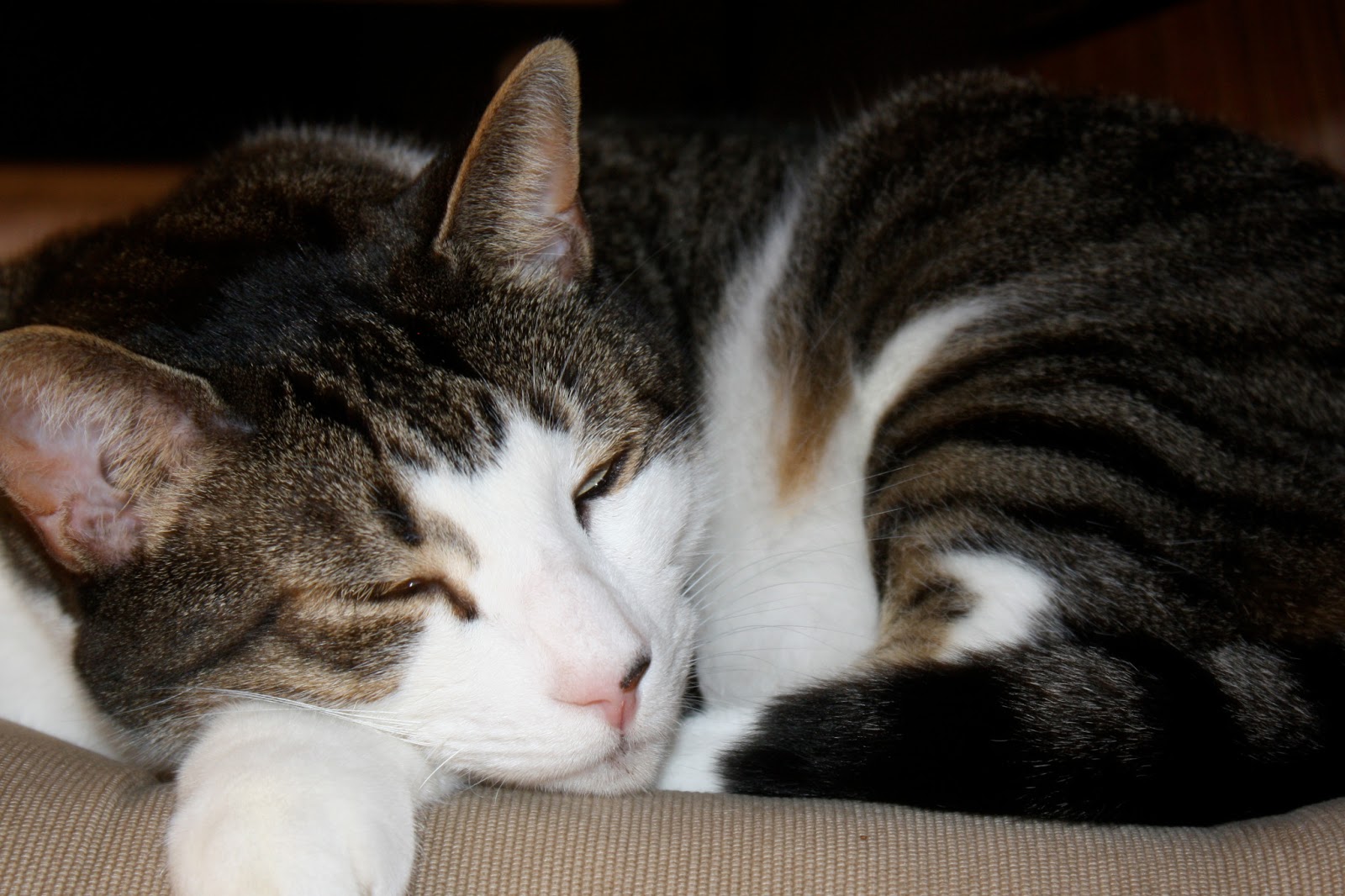 |
| Tom wants to be alone |
In Raffiki, Black Berry and Lucky Little Guy's household, the cats get along better outside (where Lucky has an enclosure); but the Canadian climate means this is not an option for almost six months of the year. Inside the house, Raffiki and Black Berry refuse to come out of the bedroom when Lucky is upstairs, even if Lucky is in his very luxurious cat apartment in the living room.
Forcing them to come out is far from easy, because the senior cats have illnesses that can be made worse by stress and because the open plan of their home makes it easy for them to hide elsewhere. Besides, their purrsons are reluctant to force anything, having has to intervene in too many cat fights.
In this situation, one of the best things they can do is to pool their catnip allowances to hire someone to cut an opening in the bottom third of the bedroom door and securely line it with hardware cloth - so they can start establishing visual access with Lucky, without having to have physical contact with him. It would start with the opening being fully covered over (with, say, cardboard) and then, as all cats get used to it, raising it an 2.5 cm (1 American inch) at a time; letting everyone get used to that before moving it up yet another inch - until all is fully revealed. This gives everyone a chance to adapt to full visual access and yet no one can harm the other because their paws won't fit through this extra-thick screening.
You can gather than theirs will be a slow process. But moving slowly in the right direction is much better than not at all.
So as you can see, while each family is asked to follow the same set of guidelines, the way in which they are implemented varies with the household. Besides purrsons often lack the confidence (or know-how) to understand when we are truly ready for the next step in the introduction process, and so they like to e-mail me just to be sure. And sometimes there are setbacks and everyone needs re-assurance of how to get the situation under control.
So while you are reading the blog entries, know that many times they are the result of more frequent e-mails back-and-forth to settle the details with the respective households.
And if you are interested in following the adventures of the three cat families in this entry, here are the blog entries about them to date:
Raffiki, Black Berry and Lucky Little Guy
Three Black Cats Who Don't Get Along (8/14/12)
Three Black Cats Who Don't Get Along: Progress Report (9/18/12)
Tom, Gracie and Spike
Newcomer Hampers Sick Cat's Recovery (4/4/11)
Re-integration After Disaster: Old and Young Cats (5/4/11)
And Now We Are 3: Getting Used to Another Cat (12//3112)
Getting Used to a Third Cat: Tommy, Gracie and Spike (1/14/13)
Buddy, Patches and Max
Cat Fights in the Family: For Buddy the Pressure is TOO Much (12/30/12)
Keep your paws crossed that there are happy endings for each of these families. With knowledge, patience, and consistency, such integration usually works.
Purrs and whisker kisses,
Greyce


Monday, January 14, 2013
Getting Used to a Third Cat: Tommy, Gracie and Spike
Dear Greyce,
Things have developed s-l-o-w-l-y but we are at a loss for the next step. So let me review our progress to date.
We have undertaken scent exchange by getting to smell Spike's blanket (without Spike, of course). Gracie is interested, whereas I sniff and go.
Spike is housed in the Workroom adjacent to the Basement. He now has access to the Basement several times a day. He still is separated from us because there is a door (with a cat door) leading to the basement. It is locked when he is about. And we are elsewhere.
Spike goes outside from time and time and likes to look at us through the window. I usually ignore him unless he gets far too close (nose-to-nose except separated by a window) and then I hiss. Gracie is the flirt; she chirps and she puffs herself up.
Gracie has a ton of energy and wants to play all the time. We have several cat trees, cat scratchers and viewing places, along with lots of toys. Still she bugs me. So purrhaps having a younger cat to play with will keep her occupied. I'm more sedentary (I'm 10+ years after all) and I have a weight problem which makes jumping a hard task. Herself added some stairs to help me reach the bed at night.
So now what?
Tommy
Things have developed s-l-o-w-l-y but we are at a loss for the next step. So let me review our progress to date.
We have undertaken scent exchange by getting to smell Spike's blanket (without Spike, of course). Gracie is interested, whereas I sniff and go.
Spike is housed in the Workroom adjacent to the Basement. He now has access to the Basement several times a day. He still is separated from us because there is a door (with a cat door) leading to the basement. It is locked when he is about. And we are elsewhere.
Spike goes outside from time and time and likes to look at us through the window. I usually ignore him unless he gets far too close (nose-to-nose except separated by a window) and then I hiss. Gracie is the flirt; she chirps and she puffs herself up.
Gracie has a ton of energy and wants to play all the time. We have several cat trees, cat scratchers and viewing places, along with lots of toys. Still she bugs me. So purrhaps having a younger cat to play with will keep her occupied. I'm more sedentary (I'm 10+ years after all) and I have a weight problem which makes jumping a hard task. Herself added some stairs to help me reach the bed at night.
So now what?
Tommy
Monday, December 31, 2012
And Now We Are 3: Getting Used to Another Cat
Dear Greyce,
When you last advised me, I was having a heck of a time adjusting to Gracie, the interloper, and I became seriously ill. (See previous entries, Newcomer Hampers Sick Cat's Recovery - April 4, 2011; then Re-integration After Disaster - May 6, 2011).
I'm happy to say that's all behind us now and having another feline in the house has become quite fine.
And then . . . .
IT HAPPENED AGAIN! There is yet another interloper seeing refuge. His name is Spike and he is a stray.
Herself is being more careful in this matter, especially since my health was so impacted the last time. And yet her heart goes to Spike who is used to being outdoors, very much wants shelter and for whom there is no room elsewhere.
He started out in a safe room in our home but disrupted everything by wanting to get out. He meowed and cried non-stop day and night and I found this really upsetting. Herself would play with him but it was never enough! So much for Plan A.
As a compromise, Herself gave him the use of a workshop attached to the garage. He has his own area there and it is heated, furnished with toys and the necessities of life. That was fine with me.
Now he goes outside but for a short while (he's a great hunter) and will either come back when called or when he is hungry. So I guess he knows he has a safe place to stay.
To start getting us used to the idea, Herself has brought a blanket he lies on inside the house for us to smell. We sniff it a lot and then walk away.
About two weeks ago, Spike took a walk outside and stared at us through the front door. Gracie reacted like a lovesick teenager, chirping and flirting. Me, not so much. Just looked.
I have seen Spike a few times through the front door when he is outside. I hissed once when we were almost nose-to-nose through the glass (guess it was a bit too close for my liking). Gracie still behaves like a brazen hussy.
Spike has made it known that he would like to come inside the house. Now when he goes outside, he plays for a short while and then comes to the front door to stare at us. He also looks in the back window (into the kitchen) and cries.
What should we do?
Hoping for an answer,
Tommy
 |
| Tommy |
 |
| Gracie |
And then . . . .
IT HAPPENED AGAIN! There is yet another interloper seeing refuge. His name is Spike and he is a stray.
Herself is being more careful in this matter, especially since my health was so impacted the last time. And yet her heart goes to Spike who is used to being outdoors, very much wants shelter and for whom there is no room elsewhere.
He started out in a safe room in our home but disrupted everything by wanting to get out. He meowed and cried non-stop day and night and I found this really upsetting. Herself would play with him but it was never enough! So much for Plan A.
As a compromise, Herself gave him the use of a workshop attached to the garage. He has his own area there and it is heated, furnished with toys and the necessities of life. That was fine with me.
Now he goes outside but for a short while (he's a great hunter) and will either come back when called or when he is hungry. So I guess he knows he has a safe place to stay.
To start getting us used to the idea, Herself has brought a blanket he lies on inside the house for us to smell. We sniff it a lot and then walk away.
About two weeks ago, Spike took a walk outside and stared at us through the front door. Gracie reacted like a lovesick teenager, chirping and flirting. Me, not so much. Just looked.
I have seen Spike a few times through the front door when he is outside. I hissed once when we were almost nose-to-nose through the glass (guess it was a bit too close for my liking). Gracie still behaves like a brazen hussy.
Spike has made it known that he would like to come inside the house. Now when he goes outside, he plays for a short while and then comes to the front door to stare at us. He also looks in the back window (into the kitchen) and cries.
What should we do?
Hoping for an answer,
Tommy
Sunday, December 30, 2012
Cat Fights in the Family: For Buddy the Pressure is TOO Much
Dear Greyce,
I'm afraid our holiday season is not a happy one and we are asking for your help. Simply put, our family has fallen apart!
Let me start at the beginning.
About four years ago we settled into a household as a family, that family being Patches (a charming female) who was already an adult and moi, Buddy, just nine weeks old; we live with Herself. Patches is the relaxed and friendly one and I am the more nervous (but friendly) one. And we bonded well.
Three months ago things changed, with the arrival of a new kitten called Max. He started off in a spare room and then was gradually introduced to us. We put up with him.
And then . . . all hell broke loose.
Patches went to the vet to get her teeth cleaned. Upon her return she smelled different. Herself kept Patches in a separate room to adjust to being home. We had a little scuffle. I should mention that on two other occasions many years ago, when Patches came home smelling different I had the same reaction. But after we were separated for a day or so, things got back to normal. Not so this time.
I was sent to the basement (my favourite hang out). About 10 days after the scuffle, I howled to be let up
but as soon as I saw Patches I attacked her. Back to the basement for me. Another two weeks, another incident (even worse, but I'll spare you the details).
We have been eating on either side of a door that is open a tiny bit. We are fine until we finish our meals. Then I get an angry look on my face and Herself has to close the door.
So all in all, I see my former best friend as my enemy. I think the pressure of the new guy, Max, plus Patches dentistry-at-the-vet smell has been too much for me to bear.
I have been examined by the vet and pronounced healthy. I'm on a food supplement to relax me; it is called Zylcene and is made from a milk protein. And there are four Feliway diffusers at different locations in the house. We have three cats trees and lots of toys. Herself believes she has everything dealt with, in terms of anxiety-reduction measures.
So here is the current situation: Patches and Max are now a tight twosome. They get one area and I get another and then we swap daily on a time-share basis. I'm okay with Max as well although he makes me a little nervous (being an energetic kitten).
Herself thinks she has broken up our happy family and is beside herself with guilt.
How to we get to be a real family again?
Anxious and anxiously awaiting your reply,
Buddy
I'm afraid our holiday season is not a happy one and we are asking for your help. Simply put, our family has fallen apart!
Let me start at the beginning.
About four years ago we settled into a household as a family, that family being Patches (a charming female) who was already an adult and moi, Buddy, just nine weeks old; we live with Herself. Patches is the relaxed and friendly one and I am the more nervous (but friendly) one. And we bonded well.
Three months ago things changed, with the arrival of a new kitten called Max. He started off in a spare room and then was gradually introduced to us. We put up with him.
And then . . . all hell broke loose.
Patches went to the vet to get her teeth cleaned. Upon her return she smelled different. Herself kept Patches in a separate room to adjust to being home. We had a little scuffle. I should mention that on two other occasions many years ago, when Patches came home smelling different I had the same reaction. But after we were separated for a day or so, things got back to normal. Not so this time.
I was sent to the basement (my favourite hang out). About 10 days after the scuffle, I howled to be let up
but as soon as I saw Patches I attacked her. Back to the basement for me. Another two weeks, another incident (even worse, but I'll spare you the details).
We have been eating on either side of a door that is open a tiny bit. We are fine until we finish our meals. Then I get an angry look on my face and Herself has to close the door.
So all in all, I see my former best friend as my enemy. I think the pressure of the new guy, Max, plus Patches dentistry-at-the-vet smell has been too much for me to bear.
I have been examined by the vet and pronounced healthy. I'm on a food supplement to relax me; it is called Zylcene and is made from a milk protein. And there are four Feliway diffusers at different locations in the house. We have three cats trees and lots of toys. Herself believes she has everything dealt with, in terms of anxiety-reduction measures.
So here is the current situation: Patches and Max are now a tight twosome. They get one area and I get another and then we swap daily on a time-share basis. I'm okay with Max as well although he makes me a little nervous (being an energetic kitten).
Herself thinks she has broken up our happy family and is beside herself with guilt.
How to we get to be a real family again?
Anxious and anxiously awaiting your reply,
Buddy
Saturday, August 25, 2012
Cats Trying to Get Used to Each Other: Shushi and Chocho
Dear Greyce,
I am a very beautiful, 7-year-old, spayed female who is used to being queen of the castle (apartment, actually). I am independent and not overly affectionate; but I do enjoy having my head and back stroked.
I tend to be reactive (that is, a bit jumpy).
Until recently, I've lived with Herself, Herself's Mother and Herself's Brother (the latter who doesn't have much to do with my care). From time to time we have had feline guests because Herself is involved in cat rescue. But now is another matter entirely.
Less than two month ago, a feline stranger arrived. He was in rough shape because he needed to have his leg amputated. Apparently he was a stray and was found wandering about the streets minus a front paw with a bone sticking out! Of course surgery was essential. And now he is in my home and expects to stay there!
Chocho (his name) is less than a year old. He is a black shorthair and will soon be neutered. He has his own room (with food, water, toys and litter box) and mostly tends to hide during the day. Oh, he will come out if there is food but will leave at the first sign of movement from a purrson. At night he plays, eats and uses the toilet. He loves food (wet, dry or treats) - unlike myself who is very particular. And he is talkative and becoming more so.
He is frightened of people. Herself knows this so she talks to him softly and leaves a radio on to keep in company when he is alone in the room; purrhaps this will help him get used to human sounds. At first he didn't want to be touched. But now he lets Herself stroke his back. She thinks it is because she put a Feliway diffuser in his room and that has helped him become more comfortable.
Everything was fine until Herself decided that I should meet Chocho. At first, we were separated by a mesh door which separates the apartment from the balcony. I am only allowed out on the balcony when I am supervised, so I am safe. When we got to the point that we no longer reacted to the sight of one another, Herself and the vet decided it was a good time to open the door and let us have more interaction.
When that happened, I stayed where I was. I was not about to go and greet the intruder! Chocho approached, chirping at me like I was a long-lost friend. Well, I would have none of that. I crouched and started to flick my tail. Then I hissed at him and so he retreated (thank goodness).
Herself decided to arrange these meetings between the two of us, every morning and every evening. I continue to hiss and he got more anxious. Now he knows that if he stays away from me, we can both just lie down and look at each other - for up to 20 minutes - before retreat.
Well Greyce, the problem is this. I read your blog entry about introductions. And I don't want to use the cat carrier method of getting us in closer contact. Either does Chocho. We both HATE the carrier!
Dear Shushi,
It may be difficult for you to understand, Shushi, but I do think that Chocho wants to get to know you better. He is probably attracted to your beauty, in addition to the fact that you are the only other one of his kind in this home. I'm sure he could use the guidance of an older woman to help him adjust to his new situation.
 |
| Shushi |
I am a very beautiful, 7-year-old, spayed female who is used to being queen of the castle (apartment, actually). I am independent and not overly affectionate; but I do enjoy having my head and back stroked.
I tend to be reactive (that is, a bit jumpy).
Until recently, I've lived with Herself, Herself's Mother and Herself's Brother (the latter who doesn't have much to do with my care). From time to time we have had feline guests because Herself is involved in cat rescue. But now is another matter entirely.
Less than two month ago, a feline stranger arrived. He was in rough shape because he needed to have his leg amputated. Apparently he was a stray and was found wandering about the streets minus a front paw with a bone sticking out! Of course surgery was essential. And now he is in my home and expects to stay there!
 |
| Chocho |
He is frightened of people. Herself knows this so she talks to him softly and leaves a radio on to keep in company when he is alone in the room; purrhaps this will help him get used to human sounds. At first he didn't want to be touched. But now he lets Herself stroke his back. She thinks it is because she put a Feliway diffuser in his room and that has helped him become more comfortable.
Everything was fine until Herself decided that I should meet Chocho. At first, we were separated by a mesh door which separates the apartment from the balcony. I am only allowed out on the balcony when I am supervised, so I am safe. When we got to the point that we no longer reacted to the sight of one another, Herself and the vet decided it was a good time to open the door and let us have more interaction.
When that happened, I stayed where I was. I was not about to go and greet the intruder! Chocho approached, chirping at me like I was a long-lost friend. Well, I would have none of that. I crouched and started to flick my tail. Then I hissed at him and so he retreated (thank goodness).
Herself decided to arrange these meetings between the two of us, every morning and every evening. I continue to hiss and he got more anxious. Now he knows that if he stays away from me, we can both just lie down and look at each other - for up to 20 minutes - before retreat.
Well Greyce, the problem is this. I read your blog entry about introductions. And I don't want to use the cat carrier method of getting us in closer contact. Either does Chocho. We both HATE the carrier!
What do you advise?
Shushi
___________________________
Dear Shushi,
It may be difficult for you to understand, Shushi, but I do think that Chocho wants to get to know you better. He is probably attracted to your beauty, in addition to the fact that you are the only other one of his kind in this home. I'm sure he could use the guidance of an older woman to help him adjust to his new situation.
At present just keep on with what you are doing. Don't try to do more. You can do less (that is, revert to staying behind the screen door) if either of you becomes more anxious.
My reasons are as follows:
First, Shushi, you are a reactive cat, which means you get jumpy. You are also much older than Chocho. And you are the resident cat (that is, the first cat to live here). That means that any introduction to a new cat must go at the pace at which you are comfortable.
Chocho is younger and thus more resilient (even though he has had a hard life). He is also eager to make friends with you which suggests he will be willing to take you on your terms, as long as everyone understands what those terms are.
Chocho is younger and thus more resilient (even though he has had a hard life). He is also eager to make friends with you which suggests he will be willing to take you on your terms, as long as everyone understands what those terms are.
Now Shushi, you are 7. The general rule is that it can take about one month for every year of the oldest, resident cat's age, to properly introduce another cat. You have several months to go!
Second, the purrson who needs to understand this the most is Herself, who is likely not used to the subtle ways of cat communication. When the two of you lie down and stare at each other, you are speaking quite clearly and loudly - just in a way that humans cannot hear. I believe your staring matches are likely a subtle form of aggression with the loser of the contest retreating at the end of the battle. Of course there is no fight, so the human thinks everything is going well.
I have assigned some homework on cat signalling for Herself - namely reviewing blog entries by another purrson, Amy Shojai, who knows a lot about cats. She has a series on cat communication for humans starting with http://cats.about.com/od/
(you can click on the rest from this entry - eyes, tails, etc.). And it will help Herself understand what you and Chocho are saying to one another.
Third, whatever the current situation, Chocho is likely to be neutered soon. He will be under stress with the operation and recovery. You want him pretty much fully recovered before we advance the introduction process. In fact, I'm sure that for the first few days, he might be most comfortable just confined to his room, with visits from Herself, of course. So for now, let's just hold steady at the level you are at comfortably now.
Fourth, the only thing I want to introduce now is the concept of distraction. I would prefurr that we break up these staring matches because I would rather that one of you not intimidate the other. Instead I'd like you to realize that being in the presence of the other might be quite pleasant. AND I would also like Herself to use a method which will help Chocho keep at a respectful distance from you, that is, a distance at which you feel comfortable. Usually, to keep you both at a decent distance safely, I recommend the use of leash and harness, or cat carrier, or some kind of separating device. From what you have explained to me (privately), I do not think we can try these right now. Both of you are so skittish (and detest carriers) that I think they would stress you out even more. And that would not be a good idea.
Third, whatever the current situation, Chocho is likely to be neutered soon. He will be under stress with the operation and recovery. You want him pretty much fully recovered before we advance the introduction process. In fact, I'm sure that for the first few days, he might be most comfortable just confined to his room, with visits from Herself, of course. So for now, let's just hold steady at the level you are at comfortably now.
Fourth, the only thing I want to introduce now is the concept of distraction. I would prefurr that we break up these staring matches because I would rather that one of you not intimidate the other. Instead I'd like you to realize that being in the presence of the other might be quite pleasant. AND I would also like Herself to use a method which will help Chocho keep at a respectful distance from you, that is, a distance at which you feel comfortable. Usually, to keep you both at a decent distance safely, I recommend the use of leash and harness, or cat carrier, or some kind of separating device. From what you have explained to me (privately), I do not think we can try these right now. Both of you are so skittish (and detest carriers) that I think they would stress you out even more. And that would not be a good idea.
So what I recommend is distraction. When one or both of you is distracted, you don't have time to stare at the other because you are busy doing something else. It will also keep you at a safe distance from each other.
New Rules for You
New Rules for You
Rule One: Choose Distractors That You Like
- a favourite toy to keep you occupied. Possibly introduced or thrown near you (and away from the other cat). If both of you like toys, be sure that each of you has a toy nearby so you don't want to go after the other's one.
- Herself using a fishing-pole type toy either in the air or along the ground. Is there another purrson who could help keep one of you occupied while Herself plays with the other?
- placing a food treat near you (one treat at a time). I know this will work for you Chocho but not you, Shushi. And that's fine. Purrhaps there is something else that will interest you (like a toy), Shushi. And if not, purrhaps you will just be relieved that Chocho is occupied by something else so you don't have to be so watchful.
Rule Two: Use a Cat Separator If Things Get Out of Hand
Once Herself has mastered cat communication, she will be away of any signs either of you are giving that you are uncomfortable with the process or ready to start a fight. She can intervene with distraction - in advance - so that you can retreat safely and still end things positively.
Suppose one of you is about to get up to no good. One of you is approaching the other, and the other is showing signs of discomfort. Or there are yowls. First try distraction. Second Herself can try one short, sharp, "No". If those fail, use a Cat Separator.
A Cat Separator (described in my recent entry, 3 Black Cats Who Don't Get Along) can keep you apart and guide one of you to safety. (Note: In that entry I suggest Corplast but I'm not sure Corplast is available where you live. Strong cardboard is also suitable for a Cat Separator.)
Rule Three: Keep Sessions Short. Work Up Slowly.
Keep the sessions short and work up very slowly. Sessions that are too long can be stressful and can result in a build up on negative behaviour. No one needs that. A session of 20 minutes (which is your current time) is sufficient right now. Try to incorporate distraction. If it works nicely, Herself can s-l-o-w-l-y increase the session lengths by no more than one-minute per day (that is, Day 1 - morning 20 minutes, evening 20 minutes; Day 2 - morning 21 minutes, evening 21 minutes, Day 3 - morning 22 minutes, evening 22 minutes). But frankly lengthening the sessions would be better left until after Chocho has been neutered (unless his neutering is delayed) - because his recovery will take a bit of time and you will have to re-start with shorter sessions again, just so the two of you get used to everything once more.
Rule Four: Stop A Session At the First Sign of Discomfort - Even If Your Time Is Not Up
If either of you shows signs of discomfort and distraction is not working, the session MUST end immediately. Also there may come a point where the length of the session is making you weary. At that point, cut back on the length of the session by a few minutes (more if needed) and slowly increase again. Don't worry, this is the recipe for success. And going slowly is better than going too quickly.
Rule Five: Make Sure Your Purrson Relaxes
You are fortunate to live with a kind and caring purrson who wants the best for both of you. But I fear she may been so concerned about what is happening between the two of you that she is becoming stressed as well. Remind her that before she starts any session with the two of you, she should remind herself to relax by taking slow, deep breaths (10 of them is a good number). And any time she feels herself becoming tense (or one of you is tensing up) she should remember this slow, deep breathing and do it again. This will help keep her breathing and posture relaxed (and these are important cues for your cats that assure you that all is well).
I have asked you (privately) to provide me with more information on your routines and habits, as well as the way your place is furnished and laid out. When I receive it, I will advise you on ways of reducing your stress (even when you are not in the same room). Such stress reduction (and confidence building) is an important part of the overall action plan.
I look forward to hearing from you,
Greyce
Rule Two: Use a Cat Separator If Things Get Out of Hand
Once Herself has mastered cat communication, she will be away of any signs either of you are giving that you are uncomfortable with the process or ready to start a fight. She can intervene with distraction - in advance - so that you can retreat safely and still end things positively.
Suppose one of you is about to get up to no good. One of you is approaching the other, and the other is showing signs of discomfort. Or there are yowls. First try distraction. Second Herself can try one short, sharp, "No". If those fail, use a Cat Separator.
A Cat Separator (described in my recent entry, 3 Black Cats Who Don't Get Along) can keep you apart and guide one of you to safety. (Note: In that entry I suggest Corplast but I'm not sure Corplast is available where you live. Strong cardboard is also suitable for a Cat Separator.)
Rule Three: Keep Sessions Short. Work Up Slowly.
Keep the sessions short and work up very slowly. Sessions that are too long can be stressful and can result in a build up on negative behaviour. No one needs that. A session of 20 minutes (which is your current time) is sufficient right now. Try to incorporate distraction. If it works nicely, Herself can s-l-o-w-l-y increase the session lengths by no more than one-minute per day (that is, Day 1 - morning 20 minutes, evening 20 minutes; Day 2 - morning 21 minutes, evening 21 minutes, Day 3 - morning 22 minutes, evening 22 minutes). But frankly lengthening the sessions would be better left until after Chocho has been neutered (unless his neutering is delayed) - because his recovery will take a bit of time and you will have to re-start with shorter sessions again, just so the two of you get used to everything once more.
Rule Four: Stop A Session At the First Sign of Discomfort - Even If Your Time Is Not Up
If either of you shows signs of discomfort and distraction is not working, the session MUST end immediately. Also there may come a point where the length of the session is making you weary. At that point, cut back on the length of the session by a few minutes (more if needed) and slowly increase again. Don't worry, this is the recipe for success. And going slowly is better than going too quickly.
Rule Five: Make Sure Your Purrson Relaxes
You are fortunate to live with a kind and caring purrson who wants the best for both of you. But I fear she may been so concerned about what is happening between the two of you that she is becoming stressed as well. Remind her that before she starts any session with the two of you, she should remind herself to relax by taking slow, deep breaths (10 of them is a good number). And any time she feels herself becoming tense (or one of you is tensing up) she should remember this slow, deep breathing and do it again. This will help keep her breathing and posture relaxed (and these are important cues for your cats that assure you that all is well).
I have asked you (privately) to provide me with more information on your routines and habits, as well as the way your place is furnished and laid out. When I receive it, I will advise you on ways of reducing your stress (even when you are not in the same room). Such stress reduction (and confidence building) is an important part of the overall action plan.
I look forward to hearing from you,
Greyce
Friday, August 17, 2012
Queen Nina Accepts the Feline Newcomer
Dearest Precious Greyce,
Our latest developments are the greatest (see entries of June 17 and July 30, 2012 for background), even though they were triggered by Asjas being in heat. When that happened, I became extremely grumpy. So Themselves decided to do the deed: isolate Asjas completely once again and have her spayed.
Saturday morning I followed Asjas everywhere and made sure I knew exactly what she was up to. She teased me a few times and I hissed and chased her a little (not really showing any intent to do real bodily harm), And after a while I realised that as long as I react she is going to keep teasing me; so I stopped reacting. This led to her giving up trying to entice me into a chasing game.
Instead she occupied her time with moving her toys from her previous room to her new one. Themselves could not believe their eyes when they realised that she had moved all the toys she could over the barrier from her old room to her new one!
We were both totally exhausted that afternoon. So Themselves decided to give us both the peace of mind to go to sleep and isolated us again for a few hours. They also still keep us apart during the night and when they are not at home.
Our latest developments are the greatest (see entries of June 17 and July 30, 2012 for background), even though they were triggered by Asjas being in heat. When that happened, I became extremely grumpy. So Themselves decided to do the deed: isolate Asjas completely once again and have her spayed.
The operation got her all quiet and subdued for a grand total of 3 days.
During this period Themselves scrambled the kingdom a bit.
Asjas moved into the main bedroom with Himself. I slept on the couch with Herself.
This worked wonders to get Asjas into the household routine. She is now adjusted to the day/night hours dictated by Themselves and does not keep the entire household awake at night while chasing and slamming toys into walls anymore.
However those three days have passed and she is back to her chatty, chirruping self. So much for peace and quiet during the day!
To Themselves' surprise, my mood has lightened so that I'm back to normal as I've gotten used to the idea of having the interloper around. I have progressed towards accepting her to such an extent that on the weekend Themselves decided to let Asjas roam the house, while they kept a watchful eye and allowed us to control our interactions with less interference from Themselves. It was wonderful.
This worked wonders to get Asjas into the household routine. She is now adjusted to the day/night hours dictated by Themselves and does not keep the entire household awake at night while chasing and slamming toys into walls anymore.
However those three days have passed and she is back to her chatty, chirruping self. So much for peace and quiet during the day!
To Themselves' surprise, my mood has lightened so that I'm back to normal as I've gotten used to the idea of having the interloper around. I have progressed towards accepting her to such an extent that on the weekend Themselves decided to let Asjas roam the house, while they kept a watchful eye and allowed us to control our interactions with less interference from Themselves. It was wonderful.
Saturday morning I followed Asjas everywhere and made sure I knew exactly what she was up to. She teased me a few times and I hissed and chased her a little (not really showing any intent to do real bodily harm), And after a while I realised that as long as I react she is going to keep teasing me; so I stopped reacting. This led to her giving up trying to entice me into a chasing game.
Instead she occupied her time with moving her toys from her previous room to her new one. Themselves could not believe their eyes when they realised that she had moved all the toys she could over the barrier from her old room to her new one!
We were both totally exhausted that afternoon. So Themselves decided to give us both the peace of mind to go to sleep and isolated us again for a few hours. They also still keep us apart during the night and when they are not at home.
On Sunday things went even better. I had calmed down enough to
allow Asjas to roam freely without following her all the time. I simply
went back to my old routine and only payed attention to her when she
entered a room I was in. I even played along with the chasing game a few
times.
We spent a few seconds both lying on Themselves' bed; but when Herself ran to get the camera, the fire ants in Asjas' fur stirred again and she gave chase.
(Herself and Asjas even have a chasing game of their own in the mornings: Asjas will stalk Herself while she brushes her teeth, give her a light touch and turn around and run while Herself gives chase; then Asjas turns around and chases her all the way back to the bathroom, just to start the entire game again.)
That afternoon Herself toyed with the tigers' whiskers a bit more, by allowing both of us to be present while she plated our food. (We have been eating about 2 feet apart without the barrier for a while now.) As I was telling and showing Herself just exactly how hungry I was and how long it has been since I had anything to eat, Asjas entered and started telling and showing her as well.
Herself could not believe her eyes. We were both so fixated on getting our message across and getting her to hurry up that there was no sign of hostility towards each other.
Precious Greyce, Themselves are totally convinced that we would not have made this progress without your advice.
We spent a few seconds both lying on Themselves' bed; but when Herself ran to get the camera, the fire ants in Asjas' fur stirred again and she gave chase.
(Herself and Asjas even have a chasing game of their own in the mornings: Asjas will stalk Herself while she brushes her teeth, give her a light touch and turn around and run while Herself gives chase; then Asjas turns around and chases her all the way back to the bathroom, just to start the entire game again.)
That afternoon Herself toyed with the tigers' whiskers a bit more, by allowing both of us to be present while she plated our food. (We have been eating about 2 feet apart without the barrier for a while now.) As I was telling and showing Herself just exactly how hungry I was and how long it has been since I had anything to eat, Asjas entered and started telling and showing her as well.
Herself could not believe her eyes. We were both so fixated on getting our message across and getting her to hurry up that there was no sign of hostility towards each other.
Precious Greyce, Themselves are totally convinced that we would not have made this progress without your advice.
With all the respect and a thankful heart,
Queen Nina
___________________
Your Majesty,
Your letter says it all. And I am purring with pleasure.
Respectfully,
Greyce
___________________
Your Majesty,
Your letter says it all. And I am purring with pleasure.
Respectfully,
Greyce
Monday, July 30, 2012
Update on Nina and Asjas: Kitten to Cat Introduction Process
Dearest Precious Greyce,
You will recall that I summoned your assistance to deal with the relationship between my companion, Asjas, and myself, went from bad to worse. (See Introducing Kitten to Scared Cat: Nina & Asjas - June 17, 2012)
Things are improving between Asjas and myself. We have reached a point where one of us is able to explore the rest of the house while the other is kept busy in another room behind a closed door.
You will recall that I summoned your assistance to deal with the relationship between my companion, Asjas, and myself, went from bad to worse. (See Introducing Kitten to Scared Cat: Nina & Asjas - June 17, 2012)
Things are improving between Asjas and myself. We have reached a point where one of us is able to explore the rest of the house while the other is kept busy in another room behind a closed door.
Monday, June 18, 2012
Weaning a Kitten From Biting Humans: Sir Winnie's Story
Dear Greyce,
This must be your time to advise Siamese-cross cats, for I noticed that I'm not the only one of us to want your advice. My problem is that I bite people.
This must be your time to advise Siamese-cross cats, for I noticed that I'm not the only one of us to want your advice. My problem is that I bite people.
Sunday, June 17, 2012
Introducing Kitten to Scared Cat: Nina and Asjas
Dear Greyce,

Sunday, March 18, 2012
New Cat Introductions: A Plan for Eli
Dear Eli,
When I last responded to you, I promised to get back with ideas about introducing you to a new cat companion, assuming that Themselves would be bringing one into your territory in the not-too-distant future.
So here goes.
First and foremost, follow my entry, May I Introduce . . . A Cat! It is a slower-than-most introduction process because I find most humans to be in too much of a hurry and thereby they set the stage for future trouble.
So take my advice and go slow. You are the resident cat and the elder, and thus you set the pace for the process. Tell Themselves to be patient. The newcomer (likely a kitten or very young cat) will be more adaptable.
Other than following these instructions, there are only three things to keep in mind. First, you need unrestricted access to important parts of your existing territory to the extent possible. This means that if the living room is a key viewing area for you, it should not be the newcomer's domain. Instead the newcomer should be set up in another, safe room. And second, you will need assurance. So at least one of your purrsons should commit to giving you sufficient daily attention of the kind you desire - regardless of how tempting it may be for both of them to focus on the newcomer. Besides, this will be a good way to monitor your status so that the process proceeds at a pace you can handle. And third, the best time for a newcomer is when things are stable in the household - no renovations, no emotional crises or anything else to turn everything off-kilter.
That's it for now, dear. As for you question on roaming cats, I should be able to get back to you much more quickly on that.
Purrs to you,
Greyce
When I last responded to you, I promised to get back with ideas about introducing you to a new cat companion, assuming that Themselves would be bringing one into your territory in the not-too-distant future.
So here goes.
First and foremost, follow my entry, May I Introduce . . . A Cat! It is a slower-than-most introduction process because I find most humans to be in too much of a hurry and thereby they set the stage for future trouble.
So take my advice and go slow. You are the resident cat and the elder, and thus you set the pace for the process. Tell Themselves to be patient. The newcomer (likely a kitten or very young cat) will be more adaptable.
Other than following these instructions, there are only three things to keep in mind. First, you need unrestricted access to important parts of your existing territory to the extent possible. This means that if the living room is a key viewing area for you, it should not be the newcomer's domain. Instead the newcomer should be set up in another, safe room. And second, you will need assurance. So at least one of your purrsons should commit to giving you sufficient daily attention of the kind you desire - regardless of how tempting it may be for both of them to focus on the newcomer. Besides, this will be a good way to monitor your status so that the process proceeds at a pace you can handle. And third, the best time for a newcomer is when things are stable in the household - no renovations, no emotional crises or anything else to turn everything off-kilter.
That's it for now, dear. As for you question on roaming cats, I should be able to get back to you much more quickly on that.
Purrs to you,
Greyce
Wednesday, June 22, 2011
Cat Pees along Periphery of Rooms
Dear Greyce,
I am a 2 year old, spayed, declawed female with a tabby coat and yellow eyes. For the past year I've taken to peeing in fairly large amounts around the periphery of rooms in the house (except for the kitchen and the laundry room). And now it is on the increase. I've had my urine tested and it is fine.
When I urinate outside the box, Themselves take me back to where I've urinated and then to the basement for 15 or 20 minutes. They also clean the spots and then spray them. And they move my food bowl to where I have urinated. (Ha, ha! I just eat the food!)
Usually they don't see me in action. But just this morning, I did it right in front of Herself. And now I'm adding spraying to my repertoire.
I live in a multi-pet household and I think there is a problem here. My colleagues include two dogs: a) Sam (a 3 year old Cocker Spaniel spayed female) whom I adore and who adores everyone. I wash her, we play fight and we sometimes snuggle and sleep together; b) and Indy, a 5 year old, neutered male Chihuahua who is very affectionate with and protective of Herself and who likes to play with Sam. Indy is afraid of me and hides from me in his little house (to the delight of the adult children in the household).
There are two other cats as well: a) Ozzie is a 19 year old, neutered black male who is very affectionate and a little playful; but he moves slowly and is deaf; b) Misty is an 11-year old spayed female with soft, gray colours. She is vocal and affectionate with her favourites. And her very favourite purrson is Himself. She likes to play and loves being petted. She likes everyone but me!
In addition there are four humans: Themselves (male and female) and their adult children (male and female - one of whom has allergies so has minimal contact with us, and the other of whom we hardly see at all). My main purrson is Herself.
I think part (or all) of the problem is another cat in the house, Misty.
My problem started about a year ago when two things happened. First, Themselves' daughter had a bad allergic reaction and pet hair was suspected. So she would not pet or play with any of us.
Misty really took this to heart because she had been closely bonded to her. Can you imagine what it must be like to go from being the only-beloved of a purrson and then suddenly being banned from any further contact with her?
Second Misty got very sick and required extensive hospitalization. She had surgery but the vet could not find anything physically wrong with her.
When she returned home from the vet hospital, Ozzie and I growled and tried to attack her. So Misty was given her own room because the vet advised that her stress be reduced. She is now super-attached to Himself.
Now Ozzie and I have the run of the house during the day, while Misty stays in her room. Then at night, we retire to the basement and Misty takes over.
In the past three months Misty has been allowed out more often. Ozzie just ignores her but I hunt her and fight with her. At first she would fight back but now she just howls and will either run away or go back up to her room. I will sneak up on Misty when she is asleep and attack her. If I'm caught, Themselves put me in the basement for 15 or 20 minutes.
In the last two months we have all shared the space for short, supervised visits. These visits are now increasing in length and Themselves are supervising them less - unless we start to fight.
I know you want background information Greyce, so here goes:
I was a farm cat who was adopted at the age of 5 or 6 weeks. I was confined to the master bedroom for a week and then met Sam (the cocker spaniel) who is absolutely delightful. We are great pals. Then I met the other two cats, Ozzie and Misty. Ozzie was fine from the start. Misty refused to have anything to do with me!
Then I met the other dog, Indy, who was scared of me and kept his distance. He still does - for good reason, because I can be aggressive.
About 3 to 4 weeks later I was let out of the room with one pet at a time, until we all became accustomed to one another.
As for me: I prefurr to be largely on my own (except for Sam) for I am not a lap cat. The only human contact I truly desire involves playing games with string or toy mice. I'm strictly indoors but enjoy looking out the windows and meowing at the birds. When I hear or see something that is strange to me I run and hide in the basement.
My daily routine is as follows: 6 a.m. breakfast. While Themselves get ready to leave, I chase after treats in the bathroom. This is followed by a nap and/or playing with my toys (with human assistance).
I have 2 purrsonal toys - a very favourite piece of string and a toy mouse, along with a box of shared ones. I prefurr to chase toys and throw them up in the air. I also like to hunt for toys under a blanket or towel. I am a mighty hunter.
While Themselves are at work, I have the run of the upstairs with the rest of the gang (except Misty). At 6 p.m. I am given dinner and everyone returns from work. Since I am fed twice daily and there are household issues, I am served in my exclusive food dish either in the dining room or the upstairs bathroom. After dinner, I have treats for dessert.
After supper I have playtime with a human again. Around 10 p.m. I get more treats (about 10 to 15 in a day) and then I and my colleague, Ozzie, go to the basement for the night. We are confined to the basement because I would want to play in the middle of the night and for some reason all the humans wanted to do is sleep! Misty used to join us until she took sick.
While my food dish is exclusively mine, I share various water bowls and a water fountain with assorted pets. The cats in the household share three litter boxes: 2 open ones in the basement and 1 covered one in the laundry room. Misty has an additional box in the spare room which is her exclusive retreat. All boxes have unscented, non-clumping litter in them and are cleaned weekly.
I have access to all parts of the house (when we are not time-sharing) except for the adult childrens' bedrooms and the bathrooms (because I have urinated there).
There are no cat trees or scratching posts in my home, largely I think because we are all declawed.
That's all I can think of Greyce. I do hope you can help me.
Yours,
Meeka
I am a 2 year old, spayed, declawed female with a tabby coat and yellow eyes. For the past year I've taken to peeing in fairly large amounts around the periphery of rooms in the house (except for the kitchen and the laundry room). And now it is on the increase. I've had my urine tested and it is fine.
When I urinate outside the box, Themselves take me back to where I've urinated and then to the basement for 15 or 20 minutes. They also clean the spots and then spray them. And they move my food bowl to where I have urinated. (Ha, ha! I just eat the food!)
Usually they don't see me in action. But just this morning, I did it right in front of Herself. And now I'm adding spraying to my repertoire.
I live in a multi-pet household and I think there is a problem here. My colleagues include two dogs: a) Sam (a 3 year old Cocker Spaniel spayed female) whom I adore and who adores everyone. I wash her, we play fight and we sometimes snuggle and sleep together; b) and Indy, a 5 year old, neutered male Chihuahua who is very affectionate with and protective of Herself and who likes to play with Sam. Indy is afraid of me and hides from me in his little house (to the delight of the adult children in the household).
There are two other cats as well: a) Ozzie is a 19 year old, neutered black male who is very affectionate and a little playful; but he moves slowly and is deaf; b) Misty is an 11-year old spayed female with soft, gray colours. She is vocal and affectionate with her favourites. And her very favourite purrson is Himself. She likes to play and loves being petted. She likes everyone but me!
In addition there are four humans: Themselves (male and female) and their adult children (male and female - one of whom has allergies so has minimal contact with us, and the other of whom we hardly see at all). My main purrson is Herself.
I think part (or all) of the problem is another cat in the house, Misty.
My problem started about a year ago when two things happened. First, Themselves' daughter had a bad allergic reaction and pet hair was suspected. So she would not pet or play with any of us.
Misty really took this to heart because she had been closely bonded to her. Can you imagine what it must be like to go from being the only-beloved of a purrson and then suddenly being banned from any further contact with her?
Second Misty got very sick and required extensive hospitalization. She had surgery but the vet could not find anything physically wrong with her.
When she returned home from the vet hospital, Ozzie and I growled and tried to attack her. So Misty was given her own room because the vet advised that her stress be reduced. She is now super-attached to Himself.
Now Ozzie and I have the run of the house during the day, while Misty stays in her room. Then at night, we retire to the basement and Misty takes over.
In the past three months Misty has been allowed out more often. Ozzie just ignores her but I hunt her and fight with her. At first she would fight back but now she just howls and will either run away or go back up to her room. I will sneak up on Misty when she is asleep and attack her. If I'm caught, Themselves put me in the basement for 15 or 20 minutes.
In the last two months we have all shared the space for short, supervised visits. These visits are now increasing in length and Themselves are supervising them less - unless we start to fight.
I know you want background information Greyce, so here goes:
I was a farm cat who was adopted at the age of 5 or 6 weeks. I was confined to the master bedroom for a week and then met Sam (the cocker spaniel) who is absolutely delightful. We are great pals. Then I met the other two cats, Ozzie and Misty. Ozzie was fine from the start. Misty refused to have anything to do with me!
Then I met the other dog, Indy, who was scared of me and kept his distance. He still does - for good reason, because I can be aggressive.
About 3 to 4 weeks later I was let out of the room with one pet at a time, until we all became accustomed to one another.
As for me: I prefurr to be largely on my own (except for Sam) for I am not a lap cat. The only human contact I truly desire involves playing games with string or toy mice. I'm strictly indoors but enjoy looking out the windows and meowing at the birds. When I hear or see something that is strange to me I run and hide in the basement.
My daily routine is as follows: 6 a.m. breakfast. While Themselves get ready to leave, I chase after treats in the bathroom. This is followed by a nap and/or playing with my toys (with human assistance).
I have 2 purrsonal toys - a very favourite piece of string and a toy mouse, along with a box of shared ones. I prefurr to chase toys and throw them up in the air. I also like to hunt for toys under a blanket or towel. I am a mighty hunter.
While Themselves are at work, I have the run of the upstairs with the rest of the gang (except Misty). At 6 p.m. I am given dinner and everyone returns from work. Since I am fed twice daily and there are household issues, I am served in my exclusive food dish either in the dining room or the upstairs bathroom. After dinner, I have treats for dessert.
After supper I have playtime with a human again. Around 10 p.m. I get more treats (about 10 to 15 in a day) and then I and my colleague, Ozzie, go to the basement for the night. We are confined to the basement because I would want to play in the middle of the night and for some reason all the humans wanted to do is sleep! Misty used to join us until she took sick.
While my food dish is exclusively mine, I share various water bowls and a water fountain with assorted pets. The cats in the household share three litter boxes: 2 open ones in the basement and 1 covered one in the laundry room. Misty has an additional box in the spare room which is her exclusive retreat. All boxes have unscented, non-clumping litter in them and are cleaned weekly.
I have access to all parts of the house (when we are not time-sharing) except for the adult childrens' bedrooms and the bathrooms (because I have urinated there).
There are no cat trees or scratching posts in my home, largely I think because we are all declawed.
That's all I can think of Greyce. I do hope you can help me.
Yours,
Meeka
Monday, June 20, 2011
Cat Introductions: Cat Enters Homes of Existing Cat
Dear Greyce,
You just wrote about my licking problem (Cat Continues to Lick Herself Bald) but said you would also give me advice about Elliot. He is another cat who may come to live in my house for a while starting sometime next month. Please let me know how to proceed.
Thanks,
Urs.
You just wrote about my licking problem (Cat Continues to Lick Herself Bald) but said you would also give me advice about Elliot. He is another cat who may come to live in my house for a while starting sometime next month. Please let me know how to proceed.
Thanks,
Urs.
Friday, May 6, 2011
Re-integration After Disaster: Old and Young Cats
Dear Greyce,
I am recovering quite nicely now (see Newcomer Hampers Sick Cat's Recovery 4/4/11) although I have become a picky eater. Themselves have been most kind - keeping that so-called companion (a.k.a.The Pest), Gracie, sequestered. I have my basement retreat all to myself. However rumour has it that Herself has bonded to Gracie and wants to keep her around. And I'm far from impressed. I've taken to hissing when I pass the bedroom door (when she is inside) or at Herself after she has spent time with her. What should I do?
Ready to be distressed again!
Tommy
I am recovering quite nicely now (see Newcomer Hampers Sick Cat's Recovery 4/4/11) although I have become a picky eater. Themselves have been most kind - keeping that so-called companion (a.k.a.The Pest), Gracie, sequestered. I have my basement retreat all to myself. However rumour has it that Herself has bonded to Gracie and wants to keep her around. And I'm far from impressed. I've taken to hissing when I pass the bedroom door (when she is inside) or at Herself after she has spent time with her. What should I do?
Ready to be distressed again!
Tommy
Monday, April 4, 2011
Newcomer Hampers Sick Cat's Recovery
Dear Greyce,
I am in trouble – BIG trouble.
For the past two weeks I have been very ill with Irritable Bowel Disease. So ill in fact that I have had to stay in the hospital, have lots of tests and medicines, and specialist attention. I’m home now but am having problems recovering.
Yes Greyce, I know you don’t give medical advice BUT it all started with the arrival of a new kitten.
I am in trouble – BIG trouble.
For the past two weeks I have been very ill with Irritable Bowel Disease. So ill in fact that I have had to stay in the hospital, have lots of tests and medicines, and specialist attention. I’m home now but am having problems recovering.
Yes Greyce, I know you don’t give medical advice BUT it all started with the arrival of a new kitten.
Thursday, March 3, 2011
No More Urine Spraying! Moby's Update

When I lasted contacted you (Moby's News - 7/6/10) I had stopped my medications and had started to consistently use my litter box. In other words, I had really turned a corner.
So I thought you might like an update.
I use my litter box faithfully and no longer spray.
Finally I've come to terms with my feline companion, Mick. He has his issues but I stay out of his way and so we 'live and let live'.
I adore my purrsons and they treat me like a king.
So life is good . . . VERY good!
Yours,
Moby
Saturday, November 20, 2010
Cat Introductions: Older Cat to Younger Resident Cats - Flounder's Update
Dear Greyce,
I wanted to let you know how everything is working out since your blog entry of November 15th.
This week I am feeling quite good and have even asked to come out of my room! Herself used to have to bring me downstairs, and I would cling to her even if the other cats were locked up. Now she leaves the door open, goes downstairs, and ignores me. I have the option to come out, and I always do now. Herself sits on the couch reading while I explore. The other night I even ran around bipping the catnip toy and playing! I think M. may reappear this weekend, but I am feeling more confident in the space and that will help.
Monday, November 15, 2010
Introducing an Older Cat to a Younger Cat Household: Introductions Gone Wrong
Dear Greyce,
I recently discovered your blog with great relief, as I am having difficulties adjusting to a multi-cat household. I am a 14-year-old orange female (an anomaly!) who may be part Maine Coon. I am very loyal, not much of a jumper, and like to sleep pressed against my humans. I prefer to be in whichever room of a house has people, even if it's a party. I am also very vocal and friendly and like to charm people who claim not to like cats. I prove them wrong every time!
I have been an only cat for most of the last ten years. Herself took me in when I was five and my previous purrson had become disabled. Until that point I'd lived with other cats, dogs, babies, you name it. Once Herself adopted me, I had one two-year interlude with a horrible beast of a cat who reduced me to a howling, screeching wreck who was leaving blood in the litterbox. It took me six months to get the nerve to whip him good and we did fine after that. I will still so glad when he left though. I had Herself all to myself which, in my view, is ideal. However . . .
For the past two months we have been in a much larger apartment with another woman and her two cats – M and D, both of whom are females and only a few years old (compared to my authoritative status of 14 years).
I recently discovered your blog with great relief, as I am having difficulties adjusting to a multi-cat household. I am a 14-year-old orange female (an anomaly!) who may be part Maine Coon. I am very loyal, not much of a jumper, and like to sleep pressed against my humans. I prefer to be in whichever room of a house has people, even if it's a party. I am also very vocal and friendly and like to charm people who claim not to like cats. I prove them wrong every time!
I have been an only cat for most of the last ten years. Herself took me in when I was five and my previous purrson had become disabled. Until that point I'd lived with other cats, dogs, babies, you name it. Once Herself adopted me, I had one two-year interlude with a horrible beast of a cat who reduced me to a howling, screeching wreck who was leaving blood in the litterbox. It took me six months to get the nerve to whip him good and we did fine after that. I will still so glad when he left though. I had Herself all to myself which, in my view, is ideal. However . . .
For the past two months we have been in a much larger apartment with another woman and her two cats – M and D, both of whom are females and only a few years old (compared to my authoritative status of 14 years).
Wednesday, September 22, 2010
Tiggy & Nala: More Progress
Dear Greyce,
We were so pleased to be featured recently that we wanted to give you another update. (Note: Tiggy and Nala were just featured - check the entry just before this one).
We put in a big screen door in the bedroom hallway yesterday. It goes all the way to the ceiling since I like to climb it. Themselves only have the bedroom door open while they are home and only for small periods of time - so Tiggy doesn't feel hunted. Both us cats watch each other but neither of us are running away or hissing. I even leave for quite a while, so Tiggy can have some privacy.
I am told that it will be a while longer before Tiggy and I meet without the screen door. Themselves put Tiggy in her carrier to bring her out of the room so we could swap spaces for a little while (I'd go to the bedroom and she would have the rest of the place); but she hides under the bed when she sees the carrier, so we feel that she is not ready yet. We are on the road to a happy family without screen doors, but we know there are most likely many more months before we get there!
There are bigger improvements a-foot - so should I say, a-paw? Tiggy has much more confidence. I have gained more trust in Themselves (they really are quite nice, you know) and am even friendly to house guests. And best of all, we can now make ourselves understood to Herself because she has learned cat language. She is becoming tri-lingual: tail, eyes and ears. Thank you for those cat communication resources.
Yours, Nala
We were so pleased to be featured recently that we wanted to give you another update. (Note: Tiggy and Nala were just featured - check the entry just before this one).
We put in a big screen door in the bedroom hallway yesterday. It goes all the way to the ceiling since I like to climb it. Themselves only have the bedroom door open while they are home and only for small periods of time - so Tiggy doesn't feel hunted. Both us cats watch each other but neither of us are running away or hissing. I even leave for quite a while, so Tiggy can have some privacy.
I am told that it will be a while longer before Tiggy and I meet without the screen door. Themselves put Tiggy in her carrier to bring her out of the room so we could swap spaces for a little while (I'd go to the bedroom and she would have the rest of the place); but she hides under the bed when she sees the carrier, so we feel that she is not ready yet. We are on the road to a happy family without screen doors, but we know there are most likely many more months before we get there!
There are bigger improvements a-foot - so should I say, a-paw? Tiggy has much more confidence. I have gained more trust in Themselves (they really are quite nice, you know) and am even friendly to house guests. And best of all, we can now make ourselves understood to Herself because she has learned cat language. She is becoming tri-lingual: tail, eyes and ears. Thank you for those cat communication resources.
Yours, Nala
Saturday, September 11, 2010
Tiggy & Nala: On the Right Track
Dear Greyce,
Remember us? You wrote about each of us: Tiggy's Trial and also Is Nala A Nuisance? both posted on August 16, 2010.
Oh well, purrhaps you get questions from a lot of cats who don’t get along and don’t quite have our names at the tip of your pink tongue. But we wanted to let you know how well we are doing.
As the elder cat, I (Tiggy) will go first: I am gaining confidence and getting a little vocal about coming out of the bedroom (where I am sequestered). My purrson and I have at least two long play sessions a day, as well as some down-time together. I even wake her up early for a play session!
I am out from under the bed and now usually perch on top of the dresser. Sometimes I’m at the bedroom door waiting for my folks. I also have a delightful private space under a table that has a table cloth that goes all the way to the floor.
Great news! Our purrson made us a fishing-pole toy out from a long pole and butcher’s string. Nala and I both love it.
Now over to Nala: I think my folks have learned a lot about cat communication because they seem to understand me better. I still nip a little but I must admit to getting more comfortable in my new home. I love to play and play and play. At times I will nuzzle on the lap of my purrson when she is on the couch with a soft blanket over her.
So Greyce, we are doing much, much better after following your advice. We will keep you posted.
Purrs from Tiggy and Nala
Dear Tiggy and Nala, Congratulations on your progress. By the time this entry gets posted I’m sure you will have advanced even more. Keep up the good work.
With purrs of encouragement,
Greyce
Remember us? You wrote about each of us: Tiggy's Trial and also Is Nala A Nuisance? both posted on August 16, 2010.
Oh well, purrhaps you get questions from a lot of cats who don’t get along and don’t quite have our names at the tip of your pink tongue. But we wanted to let you know how well we are doing.
As the elder cat, I (Tiggy) will go first: I am gaining confidence and getting a little vocal about coming out of the bedroom (where I am sequestered). My purrson and I have at least two long play sessions a day, as well as some down-time together. I even wake her up early for a play session!
I am out from under the bed and now usually perch on top of the dresser. Sometimes I’m at the bedroom door waiting for my folks. I also have a delightful private space under a table that has a table cloth that goes all the way to the floor.
Great news! Our purrson made us a fishing-pole toy out from a long pole and butcher’s string. Nala and I both love it.
Now over to Nala: I think my folks have learned a lot about cat communication because they seem to understand me better. I still nip a little but I must admit to getting more comfortable in my new home. I love to play and play and play. At times I will nuzzle on the lap of my purrson when she is on the couch with a soft blanket over her.
So Greyce, we are doing much, much better after following your advice. We will keep you posted.
Purrs from Tiggy and Nala
Dear Tiggy and Nala, Congratulations on your progress. By the time this entry gets posted I’m sure you will have advanced even more. Keep up the good work.
With purrs of encouragement,
Greyce
Subscribe to:
Posts (Atom)